The Aeon Herald / HISTORICAL EDITION
Park Fire Leaves a Grave Question for Relief Work
Twenty-nine relief workers died in Griffith Park, where a small brush fire overtook men equipped for road work rather than a fire emergency.
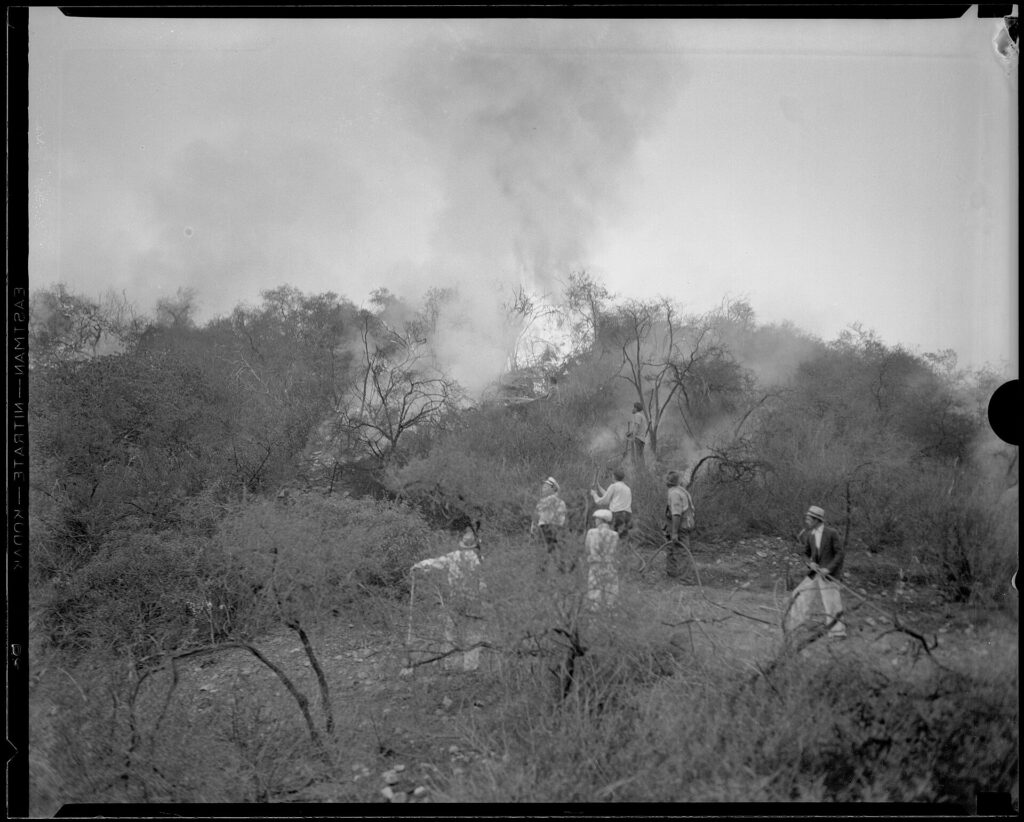
LOS ANGELES, Nov. 12.— The fire which took twenty-nine lives in Griffith Park burned less than fifty acres. Its terrible distinction lies in the number of men caught upon that small piece of ground: unemployed workers who had gone into the park to earn relief wages and found themselves in the path of a brush fire.
More than a month after the disaster of October 3, the District Attorney’s official account puts the toll at twenty-seven men killed at the scene and two who afterward died of their injuries. More than 150 others were injured. The dimensions of the burned district give little notion of the calamity. A fire can be checked within a narrow boundary and still leave a city with an appalling loss.
Nearly 3,800 relief workers were employed in the park that day. Their gangs were improving roads and bridle paths, removing brush and carrying on other park work. Picks, shovels and the strength of many hands were suited to those tasks. They did not make an organized fire department of the men who carried them.
The fire began in the Mineral Wells district, in the canyon country near the old zoo. Men went toward the burning brush with shovels and wet sacks. What appeared manageable at first became a trap when the wind changed and drove the flames up the slope. The paths by which workers had entered the canyon could not supply an escape for everyone caught below the rising fire.
The relief arrangement paid forty cents an hour for a six-hour day. Federal money loaned through the Reconstruction Finance Corporation supported the county undertaking; the city supplied projects and tools. Work permits and the allowance of working days were therefore matters of immediate consequence to households without regular wages. A foreman's direction carried more weight than an ordinary suggestion.
That circumstance makes the testimony about orders to fight the fire especially serious. Workers told the inquest that they had been directed into the fire area and feared losing their permits if they refused. Officials disputed accounts of compulsory service. The evidence must be weighed without treating all the men who approached the flames as either trained volunteers or willing fire fighters.
The park improvements were intended to put idle men to useful employment. The men who died were doing the public's work. Whatever disposition is made of the disputed orders, the disaster has laid a plain duty upon those directing such projects: the work assigned, the authority exercised and the means of protecting the workers must be considered together.
Sources & further reading
- Griffith Park Fire / The Fire of ’33 — LAFD Historical Archive; historical investigation by Mike Eberts, 1993-10.
- How Los Angeles Moved Uncomfortably Close to Mountain Wildfires — Betty Lieu Uyeda / Natural History Museums of Los Angeles County, 2023-09-25.
- Workers fighting the Griffith Park fire: image description and license — Los Angeles Times / UCLA Library Special Collections, 1933-10-03.
Related Herald reporting
- Malibu Counts the Cost of a Christmas Week Fire — William Keane, 1956-12-31.
- Bel Air’s Ruins Bring the Fire Hazard Home — Lillian Marsh, 1961-12-17.
- Clampitt Fire Leaves the Valley Counting Close Escapes — Gary Preston, 1970-10-04.
- Laguna Fire Carried a Forest Emergency Into Town — Gary Preston, 1970-12-27.
- Kanan Fire Crossed the Mountains Before Malibu Could Catch Its Breath — Sandra Beck, 1978-11-05.
- Panorama Fire Left a City With Hundreds of Homes Missing — Susan Langford, 1980-12-07.
- Wheeler Fire’s Long Campaign Ended Far From Its First Smoke — Gary Preston, 1985-07-21.
- Paint Fire Turned a Mountain Wind Into a Neighborhood Disaster — Gary Preston, 1990-07-08.
- Old Topanga Fire Tested Every Route Between the Canyons and the Coast — Gary Preston, 1993-11-14.
- Laguna Beach Reckons With a Fire That Reached the Houses — Gary Preston, 1993-11-14.
- Cedar Fire Crosses the Distance Between Forest and City — Jennifer Dalton, 2003-11-16.
- Old Fire Leaves a Burned Route From Valley to Mountain — Jennifer Dalton, 2003-11-23.
- Witch Fire Carries a Backcountry Emergency Into Rancho Bernardo — Jennifer Dalton, 2007-11-11.
- Catalina’s Fire Scar Leaves a Long Recovery Beyond Avalon — Jennifer Dalton, 2007-11-12.
- Station Fire’s Smoke Spreads Beyond the Flames in Satellite View — Andre Lawson, 2009-09-02.
- Station Fire Leaves the Angeles Forest With a Long Recovery — Jennifer Dalton, 2009-10-25.
- Thomas Fire Ends With a Second Disaster in Its Watershed — Jennifer Dalton, 2018-01-21.
- Camp Fire Search Revises the Toll as Paradise Faces Its Ruins — Jennifer Dalton, 2018-12-05.