

The Aeon Herald / HISTORICAL EDITION
Panorama Fire Left a City With Hundreds of Homes Missing
The San Bernardino disaster brought fire into residential streets, then kept crews moving between the city foothills, Devore and the mountain roads.
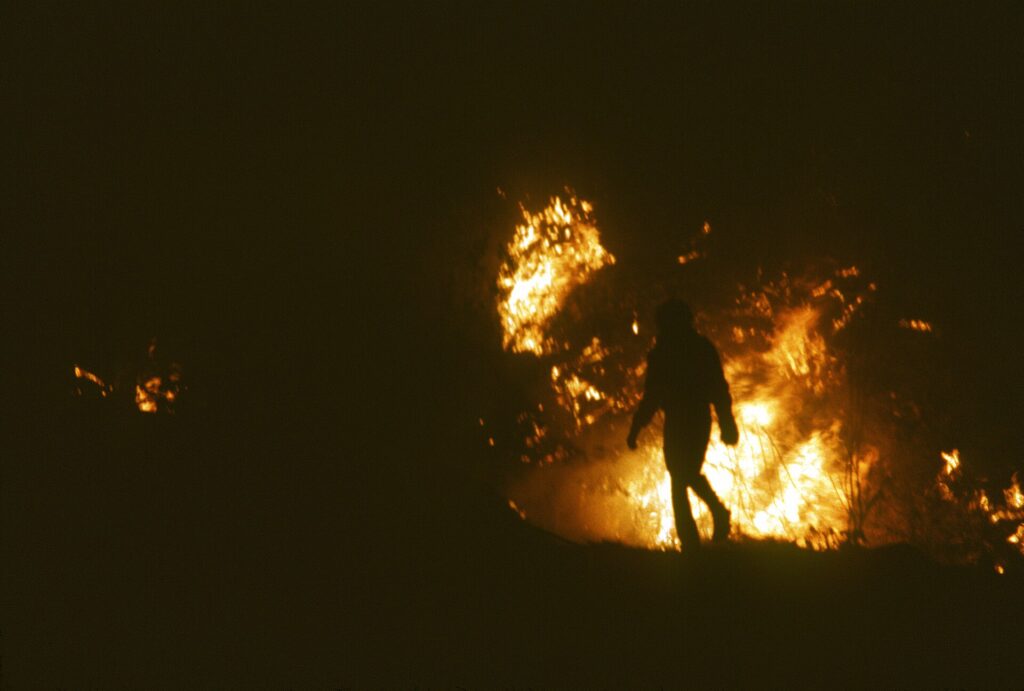
SAN BERNARDINO, Dec. 7.— The Panorama fire's most severe loss was measured within the city: 286 homes destroyed and four people dead. What began north of San Bernardino on November 24 became a residential catastrophe, driven by winds that sent the fire out of the hills and through developed neighborhoods.
The fire burned approximately 23,600 acres before its run was ended. That large perimeter included very different kinds of fighting. Crews protected houses in the foothills, worked along mountain roads and tried to hold the western advance near Devore. At the city's northeastern edge, the separate Sycamore fire added another demand upon the forces already committed.
On November 25, the Panorama flames crossed Interstate 15E and forced residents out of Devore Heights. At the other end, crews burned back from Highway 18, the Rim of the World Drive, to keep fire from crossing the mountain road. United Press International reported that the western front then moved up Cable Canyon toward less inhabited ground. These changes offered relief to one district while leaving other parts of the perimeter active.
By Friday, 2,400 firefighters were on the Panorama fire lines. By the morning after Thanksgiving, a new wind shift had directed fire toward houses on Greenwood Street in Devore Heights. Strike teams stood by for a defensive effort, with backfiring contemplated as the flames came down a canyon. Four outbuildings burned above the community; an early report that called them homes was corrected. Even the basic count of losses had to follow the changing situation on the ground.
Governor Edmund Brown Jr. toured the fire areas by helicopter on Thanksgiving and joined firefighters for their meal. He asked President Carter to declare a disaster so affected residents could obtain rebuilding loans. Those requests addressed the next stage of the emergency: households whose escape from the fire had left them without the dwelling to which they expected to return.
The statistics issued during the fighting changed as crews and assessors gained access to burned districts. A house badly damaged, an apartment unit and a detached building do not enter every count in the same way. The city's total of destroyed homes gives the clearest measure of its residential loss, while the wider acreage describes the mountain and foothill ground that carried the fire toward it.
That ground is now another concern for the valley. The fall fires stripped large parts of the mountain watershed above developed country. Fire protection and flood control thus meet on the same slopes, even after the last threatening flames are checked. For the households displaced by Panorama, however, the nearest task remains finding shelter and establishing what can be repaired, replaced or recovered from the homes they lost.
Sources & further reading
- Fire Department history — City of San Bernardino.
- Firefighters took advantage of dying winds — Joan Goulding, United Press International, 1980-11-26.
- A wind shift aimed the Panorama fire at Devore Heights — United Press International, 1980-11-28.
- Safety Background Report, table 5-1 — San Bernardino County, 2018-11-28.
Related Herald reporting
- Kanan Fire Crossed the Mountains Before Malibu Could Catch Its Breath — Sandra Beck, 1978-11-05.
- Wheeler Fire’s Long Campaign Ended Far From Its First Smoke — Gary Preston, 1985-07-21.
- Paint Fire Turned a Mountain Wind Into a Neighborhood Disaster — Gary Preston, 1990-07-08.
- Laguna Fire Carried a Forest Emergency Into Town — Gary Preston, 1970-12-27.
- Clampitt Fire Leaves the Valley Counting Close Escapes — Gary Preston, 1970-10-04.
- Old Topanga Fire Tested Every Route Between the Canyons and the Coast — Gary Preston, 1993-11-14.
- Laguna Beach Reckons With a Fire That Reached the Houses — Gary Preston, 1993-11-14.
- Bel Air’s Ruins Bring the Fire Hazard Home — Lillian Marsh, 1961-12-17.
- Cedar Fire Crosses the Distance Between Forest and City — Jennifer Dalton, 2003-11-16.
- Old Fire Leaves a Burned Route From Valley to Mountain — Jennifer Dalton, 2003-11-23.
- Malibu Counts the Cost of a Christmas Week Fire — William Keane, 1956-12-31.
- Witch Fire Carries a Backcountry Emergency Into Rancho Bernardo — Jennifer Dalton, 2007-11-11.
- Catalina’s Fire Scar Leaves a Long Recovery Beyond Avalon — Jennifer Dalton, 2007-11-12.
- Station Fire’s Smoke Spreads Beyond the Flames in Satellite View — Andre Lawson, 2009-09-02.
- Station Fire Leaves the Angeles Forest With a Long Recovery — Jennifer Dalton, 2009-10-25.
- Thomas Fire Ends With a Second Disaster in Its Watershed — Jennifer Dalton, 2018-01-21.
- Camp Fire Search Revises the Toll as Paradise Faces Its Ruins — Jennifer Dalton, 2018-12-05.
- Woolsey Fire Leaves Homes and a Piece of the Movies to Rebuild — Jennifer Dalton, 2019-01-13.