

The Aeon Herald / HISTORICAL EDITION
The Queen Mary Keeps a Night Watch on Its Ghost Stories
A published account of an overnight investigation gives Long Beach’s retired liner another set of passengers to discuss. Witness claims and documented history remain separate questions.
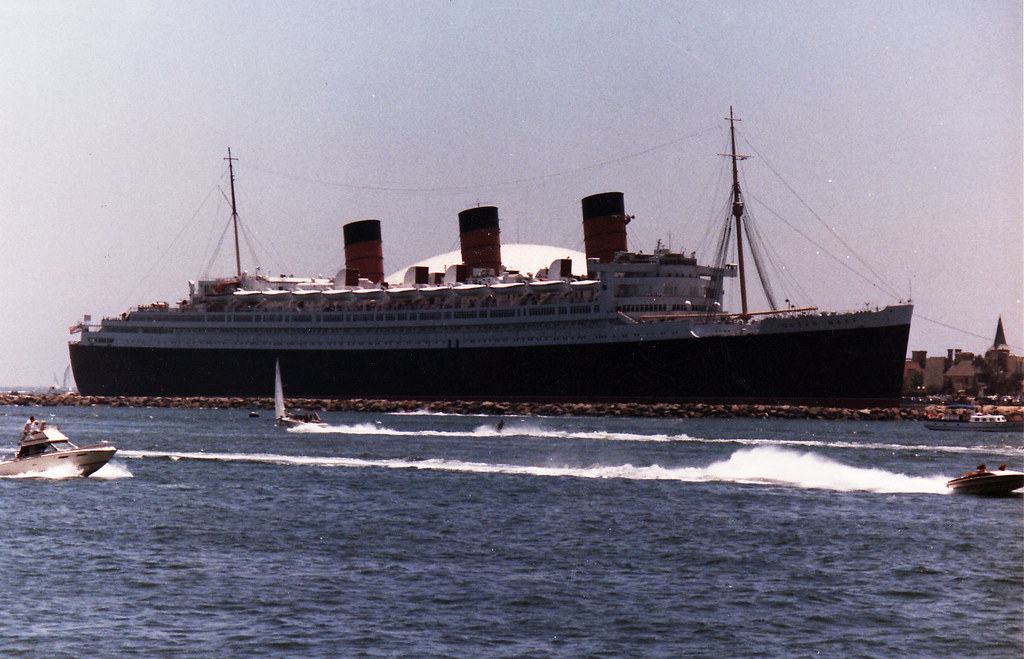
LONG BEACH — The Queen Mary is approaching the fiftieth anniversary of her maiden voyage with an inquiry into some distinctly unofficial passengers. Employees’ reports of figures, noises and unexplained disturbances have returned to local newspaper pages, adding another chapter to the retired liner’s life as a hotel and attraction.
On May 4 the Long Beach Press-Telegram republished Tom Hennessy’s account of a night aboard the liner. An editor’s note identifies it as an article written two years earlier. That is worth remembering: the new printing renews an earlier investigation; it does not mean that every experience described in it happened last week.
One witness in Hennessy’s article was security sergeant Nancy Wazny, who described seeing a woman beside the empty swimming pool and a man in work clothes near the engine-room exhibit; each, she said, vanished. Other employees reported clanging sounds and alarms in locked areas. Hennessy then described his own night investigation, including uneasy intervals in the pool area and the propeller-shaft passages.
The piece is valuable as a record of what people aboard were saying. It is not a passenger manifest for the dead. Its explanations linking particular apparitions to particular deaths depend upon records and identifications that require examination in their own right. A story can be sincerely repeated and still acquire an uncertain history along the way.
There is enough verifiable history aboard the Queen Mary without asking a ghost to provide it. She began her maiden voyage from Southampton on May 27, 1936. Her Atlantic crossings joined speed with an elaborate social world of dining rooms, public salons, stewards and tightly ordered classes of accommodation.
During the war she became a troop transport. Compartments designed for civilian travel were pressed into a different service, and the ship carried soldiers across dangerous seas. Afterward she helped bring servicemen home and transported war brides beginning new lives across the Atlantic. Those movements left a human history far larger than the recollections of celebrated first-class passengers alone.
Such a vessel also contains a history of work. Below the public rooms are the spaces in which people maintained machinery, prepared meals, stored supplies and moved the necessities of a small travelling town. The contrast between polished leisure above and concentrated labor below is part of the ship’s character, whether the visitor arrives by daylight or after midnight.
Retirement changed the meaning of those rooms. The liner reached Long Beach on December 9, 1967. Public tours followed, and the first hotel rooms opened in 1974. Under the Wrather concern’s management, the Queen has become both an attraction and a place where visitors sleep. She no longer carries people toward another port, but she remains a building full of arrivals, departures and unfamiliar sounds.
That arrangement gives the ghost inquiry its peculiar difficulty. An apparently empty section is still part of an occupied ship. Before a sound becomes a voice from elsewhere, somebody must account for where the living are, what equipment is operating and how the sound could have travelled. The inquiry needs a working plan of the vessel as much as a willingness to be startled.
The architecture provides its own contrasts. The public rooms preserve the decorative ambitions of an Atlantic liner, while the machinery spaces show how much labor stood behind the passengers’ comfort. Cabins, stairways and service passages divide that large interior into smaller worlds. To someone acquainted only with the dining rooms, the spaces below can suggest an entirely different vessel. The ship’s documented design makes that contrast clear without supplying a supernatural explanation for it.
The temptation runs in both directions. A visitor eager for a haunting can promote every knock into an answer; a visitor determined to scoff can dismiss an employee before hearing the account. Neither disposition does much useful investigating. Courtesy toward the witness and firmness about the evidence ought to be compatible.
Names deserve particular care. Finding a death in an old record is not the same thing as identifying a figure somebody believes was seen. A date, a compartment and a person should not be joined merely because they make a satisfying narrative. The historical record is there to test an account as well as decorate it. Otherwise the investigation begins by accepting the very connection it means to prove.
For Long Beach, the lasting attraction is a great ship whose ordinary past is already extraordinary. The ghost stories belong to the record of her retirement, because people tell them and others come to hear. Whether they describe additional occupants remains another question. The anniversary does not require the question to be settled before the next watch begins.
Sources & further reading
- A Haunting Night Aboard the Queen Brings Out the Ghosts— Tom Hennessy, Long Beach Press-Telegram; authorized facsimile/transcription hosted by ParaXplorer Project; May 4, 1986 reprint; editor identifies original as two years earlier.
- Timeline, Stats & Fun Facts— The Queen Mary; Undated institutional timeline; accessed November 9, 2026.
Related Herald reporting
- At the Hotel del, a Fleeting Visitor Has a Familiar Name — Sandra Beck, 1993-10-31.
- Santa Paula’s Glen Tavern Inn Makes Room for a Paranormal Convention — Brenda Daniels, 2007-07-16.
- Linda Vista’s Film Sets Draw a Second Audience of Ghost Hunters — Camille Jackson, 2010-10-31.
- The San Pedro Haunting Account Travels Beyond One House — Brenda Daniels, 2011-03-19.
- An Opening Door Gives a Gaslamp House Investigation a Visible Question — Brenda Daniels, 2012-05-06.
- Glassell Park’s ‘Ghost Writer’ House Puts Its Messages Before Visitors — Heather Maldonado, 2014-11-02.
- David Oman Recounts a Decade of Experiences on Cielo Drive — Heather Maldonado, 2016-10-16.
- New Scrutiny of the Photographs Behind the Culver City ‘Entity’ Case — Amanda Rhodes, 2021-11-15.
- Bess Houdini Ends Her Vigil After a Silent Hollywood Séance — Beatrice Lyle, 1936-11-10.