

The Aeon Herald / HISTORICAL EDITION
Laguna Beach Reckons With a Fire That Reached the Houses
The October 27 fire burned more than 14,000 acres and destroyed hundreds of buildings. A city already battered by winter floods now confronts another kind of rebuilding.
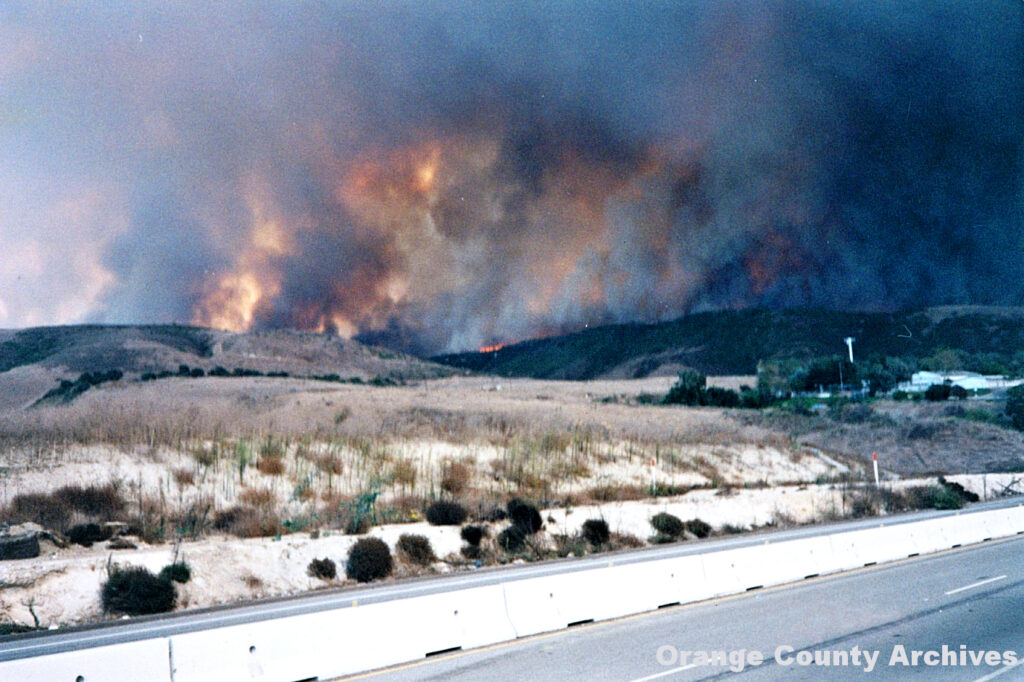
LAGUNA BEACH — The arithmetic of the October 27 fire is grim enough: more than 14,000 acres burned and 441 homes and other structures damaged or destroyed. Yet the most consequential boundary it crossed was smaller than any of those figures. A brush fire entered the built town, and houses became part of the fire. No lives were lost, a distinction of immense importance amid losses that will take far longer to repair than the flames took to inflict.
Laguna's disaster belonged to a wider Southern California emergency. Between October 24 and November 4, twenty major fires burned across six counties. Orange County had three of them. The Stagecoach fire consumed 750 acres and destroyed nine buildings; the Ortega fire burned more than 21,000 acres and destroyed nineteen. Acreage alone would therefore give a misleading account of which Orange County community suffered the heaviest destruction of its buildings.
The wind helps explain how such a contrast is possible. On October 27, strong offshore pressure sent dry air toward the coast. Instruments at Ontario recorded gusts exceeding fifty knots, while winds at Los Angeles International Airport remained comparatively light. A quiet reading at one airport did not describe conditions throughout the region. Canyons, slopes and the direction of the pressure difference made the weather dangerously uneven.
The Santa Ana is a regional name for a very local experience. Its force depends upon where the air descends and how the hills direct it. When dry vegetation burns in that moving air, burning material can travel ahead of the principal flames. A road or a cleared patch is useful ground, but it is not a promise that every ember will stop there. Distance from the main fire can be a poor measure of the remaining time.
There is a further difficulty once buildings ignite. A house is no longer merely something firefighters must defend from the brush. It can supply heat and burning material to another house. The danger then includes the spacing and construction of buildings, as well as the vegetation beyond them. Laguna's loss belongs to that troubling category of fires in which the distinction between a wildland emergency and a town emergency ceases to be useful.
For Laguna Beach, the year has already furnished an unwelcome lesson in the movement of water through the same landscape. Winter flooding damaged Laguna Canyon Road, homes and small businesses. Sandbagging did not keep water from downtown stores. That earlier disaster also took no lives. The two emergencies differ profoundly, but each has exposed the dependence of the community upon the roads and channels running between its hills and the sea.
Rebuilding a burned house and repairing a flood-damaged road are separate jobs. Their connection is the need to keep a town accessible while work proceeds. A restored building needs a dependable approach for residents, deliveries and emergency apparatus. A street serving undamaged houses can still be essential to a neighborhood whose other buildings have disappeared. The public work cannot be measured entirely by the number of private properties lost.
The absence of deaths should be recorded without turning it into a declaration that the fire was somehow bearable. Hundreds of lost or damaged buildings represent places to live and work, possessions, and the accumulated arrangements of ordinary days. The regional totals explain why the emergency was so demanding. They cannot describe the particular task now facing Laguna Beach: making its neighborhoods function again while taking seriously the wind, brush and close-set buildings that helped the fire reach them.
Sources & further reading
- Local Hazard Mitigation Plan, 1993 fire and flood histories — City of Laguna Beach, 2023.
- Orange County and Orange County Fire Authority Local Hazard Mitigation Plan — Orange County and Orange County Fire Authority, 2015-11.
- Santa Ana Winds and the Fire Outbreak of Late October 1993, NOAA Technical Memorandum NWS WR-230 — Ivory J. Small, National Weather Service, 1995-06.
- Laguna Beach fire, 1993, collection photograph — Orange County Archives.
Related Herald reporting
- Old Topanga Fire Tested Every Route Between the Canyons and the Coast — Gary Preston, 1993-11-14.
- Paint Fire Turned a Mountain Wind Into a Neighborhood Disaster — Gary Preston, 1990-07-08.
- Wheeler Fire’s Long Campaign Ended Far From Its First Smoke — Gary Preston, 1985-07-21.
- Cedar Fire Crosses the Distance Between Forest and City — Jennifer Dalton, 2003-11-16.
- Old Fire Leaves a Burned Route From Valley to Mountain — Jennifer Dalton, 2003-11-23.
- Panorama Fire Left a City With Hundreds of Homes Missing — Susan Langford, 1980-12-07.
- Witch Fire Carries a Backcountry Emergency Into Rancho Bernardo — Jennifer Dalton, 2007-11-11.
- Catalina’s Fire Scar Leaves a Long Recovery Beyond Avalon — Jennifer Dalton, 2007-11-12.
- Kanan Fire Crossed the Mountains Before Malibu Could Catch Its Breath — Sandra Beck, 1978-11-05.
- Station Fire’s Smoke Spreads Beyond the Flames in Satellite View — Andre Lawson, 2009-09-02.
- Station Fire Leaves the Angeles Forest With a Long Recovery — Jennifer Dalton, 2009-10-25.
- Laguna Fire Carried a Forest Emergency Into Town — Gary Preston, 1970-12-27.
- Clampitt Fire Leaves the Valley Counting Close Escapes — Gary Preston, 1970-10-04.
- Thomas Fire Ends With a Second Disaster in Its Watershed — Jennifer Dalton, 2018-01-21.
- Camp Fire Search Revises the Toll as Paradise Faces Its Ruins — Jennifer Dalton, 2018-12-05.
- Woolsey Fire Leaves Homes and a Piece of the Movies to Rebuild — Jennifer Dalton, 2019-01-13.
- Bobcat Fire Burns a Route Across the San Gabriels — Jennifer Dalton, 2020-12-27.
- Palisades Fire Contained Without the Loss of a Home — Jennifer Dalton, 2021-05-27.