The Aeon Herald / HISTORICAL EDITION
An Object From Another Star System Passes Through Ours
Observations of ʻOumuamua establish an interstellar visitor, with its physical nature still uncertain.

ʻOumuamua, circled at center, in a combined telescope image released on November 20, 2017. Background stars trail because the telescopes tracked the moving object; the asteroid remains an unresolved point. ESO/K. Meech et al., CC BY 4.0. Image source · Reuse terms.
HONOLULU, Nov. 21—Astronomers are studying the first known object observed passing through the solar system from interstellar space. Designated ʻOumuamua, the visitor was discovered last month after it had already swung around the Sun.
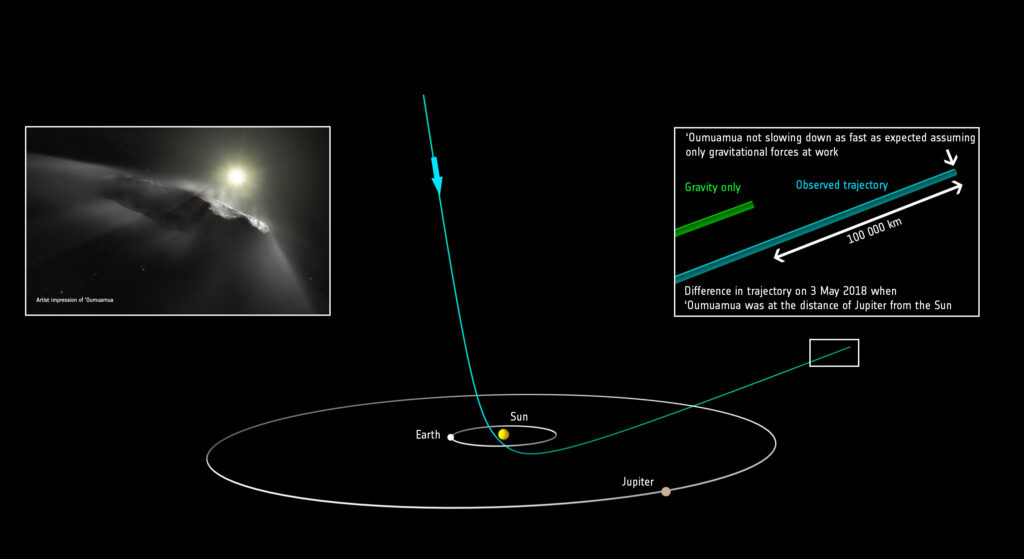
Its trajectory is the decisive evidence. It is moving on an unbound path rather than the familiar closed orbit of a solar-system asteroid. Measurements of its changing brightness suggest an unusually elongated or otherwise strongly varying shape, but it is too small and distant for an ordinary resolved portrait.
The opportunity to study it is shrinking as it moves away. Observatories have been gathering what they can about brightness, colour and motion while the object remains within reach. Those observations leave substantial uncertainty about its surface, structure and history.
An unfamiliar origin is not evidence of an artificial one. The discovery is extraordinary without that addition: material from outside the solar system has passed close enough for terrestrial instruments to recognise it. Explaining its properties will require measurements and models, rather than treating the gaps in either as a conclusion.
Sources & further reading
- ESO Observations Show First Interstellar Asteroid is Like Nothing Seen Before — European Southern Observatory, 2017-11-20.
- Interstellar Asteroid FAQs — NASA, 2017-11-20.
- Enhanced William Herschel Telescope image: file attribution and license claim — Alan Fitzsimmons / Queen’s University Belfast / ING; derivative by nagualdesign, 2017-10-28.
Related Herald reporting
- ʻOumuamua’s Small Extra Acceleration Favors a Cometary Explanation — Sarah Nguyen, 2018-06-28.
- Third Interstellar Visitor Follows a Safe Route Through the Solar System — Sarah Nguyen, 2025-07-05.