The Aeon Herald / HISTORICAL EDITION
A Claim of Signals in 234 Stars Faces an Independent Test
Patterns in survey spectra have prompted an extraterrestrial interpretation, while Berkeley researchers caution that the measurement needs confirmation.
A Canadian research team has reported repeating patterns in the spectra of 234 stars and proposed an extraordinary possible cause: extremely rapid light pulses from extraterrestrial technology. Berkeley’s Breakthrough Listen researchers have added targets to their observing program while warning that the claim is far from a confirmed detection.
Ermanno F. Borra and Eric Trottier found the patterns through a mathematical analysis of 2.5 million Sloan Digital Sky Survey spectra. The unusual cases fall mainly within a range of stellar types that includes stars resembling the Sun. The authors argue that the patterns match a prediction for very short optical pulses.
This is an inference from spectral structure, rather than a telescope recording a sequence of visible flashes in real time. That distinction makes independent observations especially important. A pattern recovered by mathematical processing must first be shown to originate in the starlight rather than the equipment or handling of the data.
In an October 11 statement, the Berkeley SETI Research Center says that instrumental optics, detector effects and data reduction can introduce small periodic features into spectra. Its researchers assess the claim at only zero or one on the zero-to-ten Rio Scale used to discuss potential SETI detections.
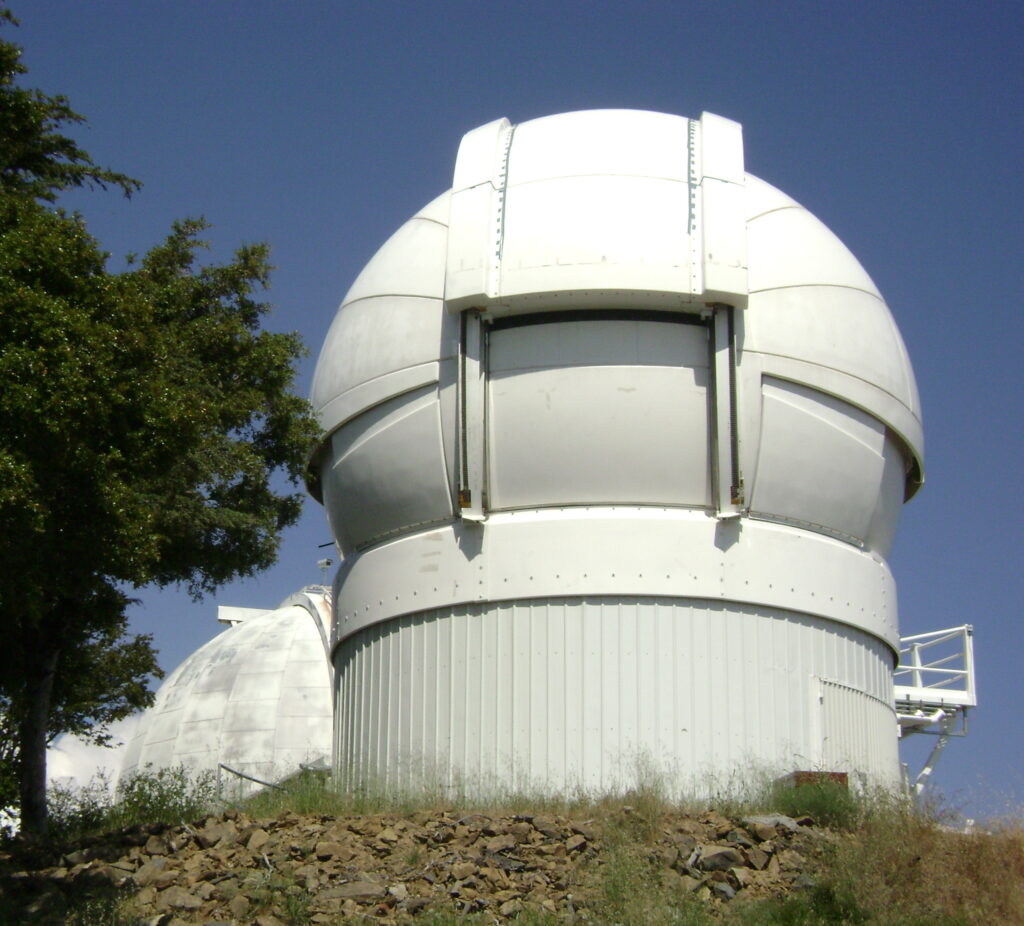
The center plans observations with the Automated Planet Finder telescope. Reproducing the feature with a different instrument would strengthen the case that something in the stars’ spectra needs explaining. It would still leave the separate task of testing natural causes before attributing the pattern to another civilization.
Borra and Trottier themselves call for further work. The present result is therefore a published claim with a testable measurement and an unusually ambitious interpretation. The next useful development will be an independent spectrum that either reproduces the feature or reveals how it arose.
Sources & further reading
- Discovery of Peculiar Periodic Spectral Modulations in a Small Fraction of Solar Type Stars — E. F. Borra and E. Trottier / research preprint; October 10, 2016.
- Breakthrough Listen at UC Berkeley to conduct follow up observations of reported anomalous spectral features in solar type stars — Berkeley SETI Research Center / Breakthrough Listen; October 11, 2016, 2:00 p.m. PDT.
Related Herald reporting
- A More Sensitive Search Leaves the Wow! Signal Unanswered — Adrian Mercer, 2001-01-12.
- An Erratically Dimming Star Draws a Search for Natural—and Artificial—Causes — Eric Bennett, 2015-10-20.
- Another Dimming Star Comes With a Disk—and a Different Puzzle — Eric Bennett, 2016-08-27.
- Seven Dyson Sphere Candidates Face a Test of What Lies Behind Them — Sarah Nguyen, 2024-05-24.
- The Proxima Signal Leads Investigators Back to Earth — Sarah Nguyen, 2021-10-26.