The Aeon Herald / HISTORICAL EDITION
Johnson Signs Civil Rights Act After Long Congressional Fight
The new law bans discrimination in public accommodations and establishes federal employment protections.
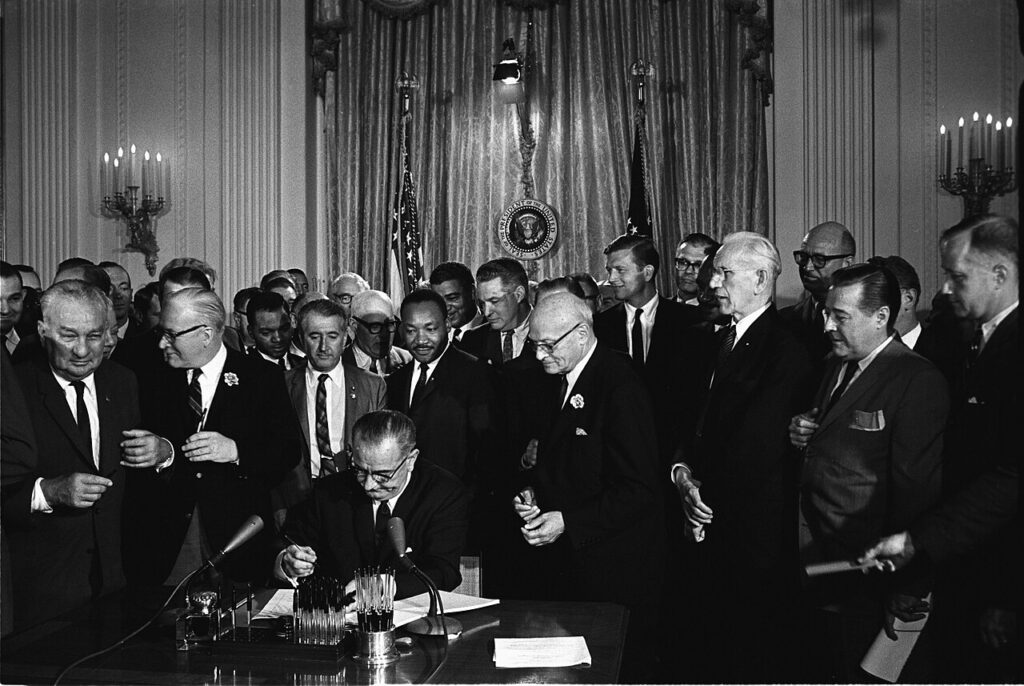
WASHINGTON, July 3.—President Johnson signed the Civil Rights Act yesterday, bringing a long and bitter legislative contest to a decisive conclusion. The measure prohibits racial discrimination in public accommodations and provides new federal means to address unequal treatment in employment and other areas of public life.
The law follows demonstrations, court battles and organising in communities where seeking an ordinary service or registering to vote could bring danger. Its passage required overcoming a prolonged Senate filibuster. The signing ceremony gave national recognition to a struggle conducted in large measure far from Washington.
The employment provisions, whose principal prohibitions are to take effect one year after enactment, cover discrimination on grounds including race, religion, sex and national origin. Enforcement machinery and the obligations of employers and public authorities will now have to be translated from the statute into practice.
No signing pen can by itself erase a habit of exclusion. But the legal position has changed: conduct defended yesterday as a local custom may now be a violation of federal law. Citizens seeking equal service have gained an instrument that the Government has an obligation to use.
Sources & further reading
- Civil Rights Act of 1964— 88th U. S. Congress; signed Lyndon B. Johnson / National Archives; July 2, 1964.
- Civil Rights AV Media Kit: photograph 276-10-WH64— LBJ Presidential Library; photograph by Cecil Stoughton; July 2, 1964 photograph; 2014 library media resource.
Related Herald reporting
- Marchers Fill Washington With Demand for Jobs and Freedom — Richard Salazar, 1963-08-29.
- Voting Rights Act Gives Federal Force to the Fight Against Racial Exclusion — Thomas Navarro, 1965-08-07.
- Montgomery Buses Desegregated as Boycott Ends — Thomas McKenna, 1956-12-22.
- Supreme Court Rules School Segregation Unconstitutional — Mary Ellison, 1954-05-18.
- Indian Voters Win Court Rulings in Arizona and New Mexico — Samuel Voss, 1948-08-08.
- Rosa Parks Dies at 92; Her Resistance Reached Beyond One Bus Ride — Monica Grant, 2005-10-25.