

The Aeon Herald / HERALD ORIGINAL
A Star Seen Through Saturn’s Rings Reveals Waves and Narrow Gaps
Voyager 2’s encounter supplies a different kind of picture, measuring ring structure by the starlight that passes through it.
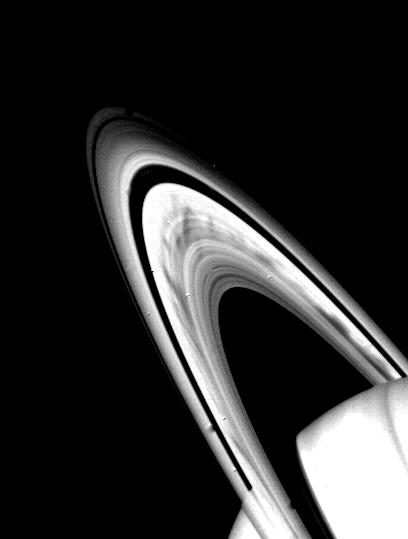
Dark spokes in Saturn’s B ring, photographed by Voyager 2 on August 3, 1981. NASA/JPL, P23881. Image source · JPL/NASA journalistic and informational image-use permission.
Voyager 2 has added a new test of Saturn’s elaborate rings: watching a star disappear and reappear behind the orbiting material. Results from last August’s encounter, published in Science, indicate that much of the rings’ fine pattern is a change in density rather than a succession of empty lanes.
The star was Delta Scorpii. Its light passed through the rings as the spacecraft’s photopolarimeter measured the changing transmission. The resulting scan typically distinguished radial structure smaller than 300 meters, far finer than the broad bands seen through an ordinary telescope.
E. C. Stone and E. D. Miner report that few true gaps remain even at that scale. At some gaps, extremely sharp edges imply a thickness below about 200 meters. That limit applies to the locations measured; it should not be treated as one uniform thickness for the entire ring system.
The instrument team, headed by A. L. Lane, finds evidence for density waves associated with gravitational resonances of satellites. Narrow strands appear within the Encke division and in the brightest part of the F ring. The rings are a moving system in which neighboring moons can organize matter into patterns.
The same instrument also examined Saturn and Titan. Titan’s atmospheric polarization could not be fitted by a simple model in which all haze particles are identical spheres. Such disagreements are useful constraints upon the models, rather than proof of a unique alternative.
Together, images and transmitted starlight allow scientists to compare the appearance of the rings with their optical structure. A dark interval in a picture need not mean there is nothing there.
Sources & further reading
- E. C. Stone and E. D. Miner — Voyager 2 Encounter with the Saturnian System, January 29, 1982; 215(4532), pp. 499–504; authorized excerpt from pp. 501–502.
- A. L. Lane and colleagues — Photopolarimetry from Voyager 2: preliminary results on Saturn, Titan, and the rings, January 29, 1982; 215(4532), pp. 537–543; original abstract.
Related Herald reporting
- Voyager Finds Ringlets, Spokes and a Shrouded Titan — Paul Norton, 1981-04-11.
- Pioneer’s Saturn Measurements Add a Ring and a Magnetic World — Paul Norton, 1980-01-26.
- Hubble Follows a Saturn Storm Around the Planet — Kevin Wallace, 1991-01-18.
- Cassini Enters Saturn Orbit and Begins a Four-Year Survey — Kevin Wallace, 2004-07-01.
- Huygens Reaches Titan and Returns a First View from the Ground — Kevin Wallace, 2005-01-15.
- Cassini Finds a Small Moon Inside Saturn’s Keeler Gap — Eric Bennett, 2005-05-11.
- Enceladus Jets Raise the Possibility of Liquid Water Beneath the Ice — Eric Bennett, 2006-03-11.
- Radar Finds a Landscape of Lakes Near Titan’s North Pole — Adrian Mercer, 2007-01-05.
- Enceladus’s Wobble Points to an Ocean Around Its Rocky Interior — Eric Bennett, 2015-09-16.
- Cassini Ends Its Saturn Tour with a Final Atmospheric Descent — Eric Bennett, 2017-09-16.
- Saturn’s Icy Rings Show a Familiar Water-Isotope Ratio, with Phoebe an Exception — Sarah Nguyen, 2018-12-04.
- Cassini’s Final Gravity Measurements Point to Relatively Young Rings — Sarah Nguyen, 2019-01-18.
- A Ten-Sided Wave Emerges Around Saturn’s South Pole — Sarah Nguyen, 2026-09-03.
- Methane Lines Give Saturn’s Atmosphere a Chemical Signature — Edward Hensley, 1933-12-01.
- A White Mark on Saturn Grows Across the Planet’s Face — Edward Hensley, 1933-08-20.
- An Erratically Dimming Star Draws a Search for Natural—and Artificial—Causes — Eric Bennett, 2015-10-20.
- Another Dimming Star Comes With a Disk—and a Different Puzzle — Eric Bennett, 2016-08-27.
- A Giant Star Nearly Vanishes Behind an Unseen Obscurer — Sarah Nguyen, 2021-06-12.
HERALD ORIGINAL
Join the conversation