

The Aeon Herald / HERALD ORIGINAL
Additional Observations Reduce 2032 Asteroid Risk to a Trace
The estimated Earth-impact probability for 2024 YR4 has fallen from about 3 percent to about 0.001 percent as its orbit becomes better known.
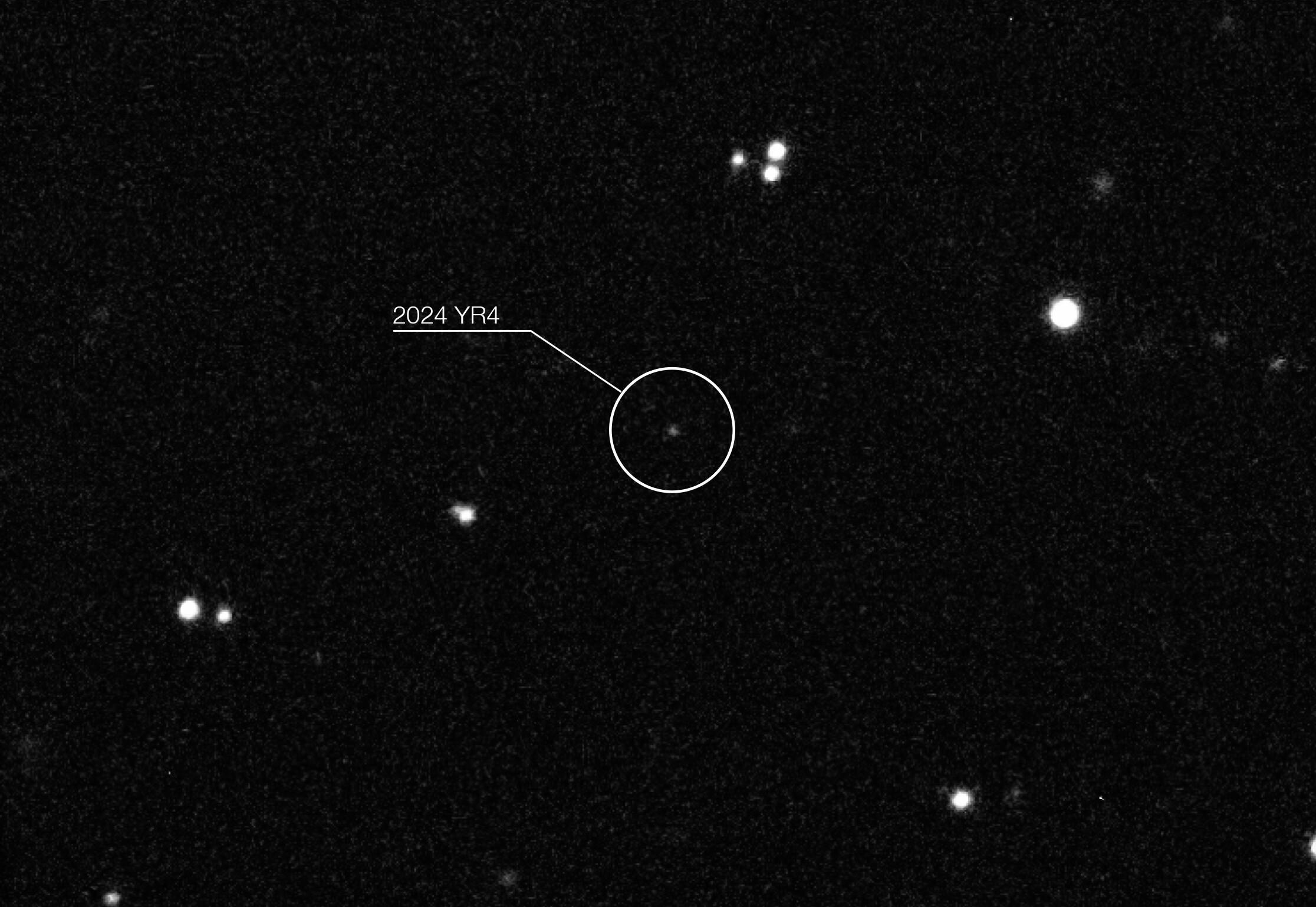
Asteroid 2024 YR4 is circled in this infrared observation made with ESO’s Very Large Telescope in January 2025. ESO/O. Hainaut, CC BY 4.0. Image source · CC BY 4.0 under ESO's explicit image-use policy; full unaltered credit required.
The European Space Agency’s February 25 update puts asteroid 2024 YR4’s estimated chance of striking Earth in 2032 at about 0.001 percent and its Torino hazard rating at zero. NASA’s February 24 announcement had already reduced its calculation to 0.004 percent, roughly one in 26,000, and said the object presents no significant potential for a future Earth impact. The revised assessment follows a period in which the probability rose above the international notification threshold.
The asteroid was discovered in late December 2024 and is estimated to be 40 to 90 meters across. Its possible December 22, 2032 encounter received particular attention because the early observational arc permitted some trajectories to intersect Earth. The estimated probability briefly reached about 3 percent before additional observations eliminated most of those paths.
The European Southern Observatory’s Very Large Telescope in Chile contributed observations during a critical part of the campaign. Astronomers were following a fading target, so each accurate position could reduce uncertainty before the asteroid became harder to observe. A dark observing sky and continued telescope access affect the quality of a risk forecast as directly as the calculation itself.
Early observations allowed for a range of possible orbits. As new measurements narrowed that range, a larger fraction of the remaining paths briefly led to an encounter with Earth in 2032. Further observations then ruled out most of those paths.
International notification procedures use a one-percent threshold for a potentially threatening object. ESA says the International Asteroid Warning Network has concluded its related activities after the reduction.
The measurements give astronomers a better estimate of this Solar System asteroid’s orbit. ESA now puts the chance of a 2032 impact at about one in 100,000.
Sources & further reading
- Latest Calculations Conclude Asteroid 2024 YR4 Now Poses No Significant Threat to Earth in 2032 and Beyond — NASA Science Editorial Team; February 24, 2025.
- ESO observations help almost fully rule out 2024 YR4 asteroid impact — European Southern Observatory; February 25, 2025.
- Asteroid 2024 YR4—latest updates — European Space Agency, Planetary Defence Office; February 25, 2025 update.
Related Herald reporting
- Bennu Tracking Narrows the Long Forecast Beyond 2135 — Sarah Nguyen, 2021-08-15.
- Radar Removes Apophis from the Century’s Impact Risk List — Sarah Nguyen, 2021-03-28.
- Chelyabinsk Study Connects a Brilliant Fireball with a Damaging Shock Wave — Kevin Wallace, 2013-11-08.
- Recovered Desert Stones Connect an Asteroid’s Predicted Impact with Its Remains — Adrian Mercer, 2009-03-28.
- Old Sky Images Remove a 2029 Impact Path for Newly Found Asteroid — Kevin Wallace, 2004-12-28.
HERALD ORIGINAL
Join the conversation