

The Aeon Herald / HERALD ORIGINAL
Radar Finds a Landscape of Lakes Near Titan’s North Pole
Dark basins and connected channels provide strong evidence for surface liquids, with methane playing a role familiar from water on Earth.
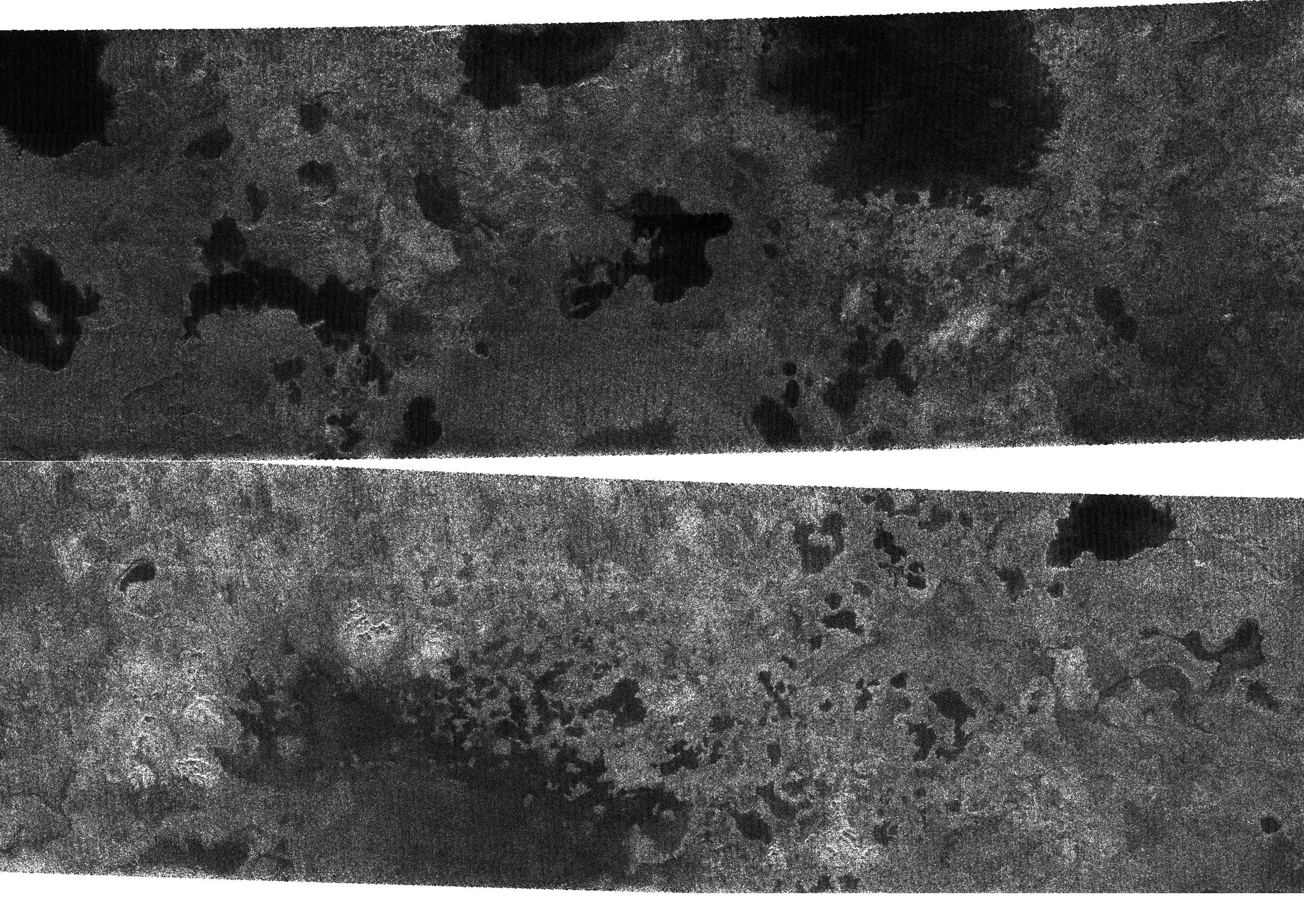
Dark lake-like patches in two Cassini radar strips near Titan's north pole, acquired July 21, 2006, and released July 24. NASA/JPL-Caltech/ASI. Image source · Reuse terms.
Radar observations from Cassini have supplied the strongest evidence yet for lakes on Titan. A paper in Nature identifies dark patches near the north pole whose shapes and surroundings are consistent with bodies of liquid, filling a major gap in the picture of Saturn’s largest moon.
The observations were made during a July 22 flyby last year. Titan’s haze hides the surface from ordinary cameras, but radar can examine its form and reflectivity. Earlier observations had shown signs of flowing liquid without establishing a present-day ocean.
Ellen Stofan and her colleagues report lakes associated with channels and depressions. Smooth surfaces return little radar energy. The combination of darkness, setting and lake-like outlines makes liquid a better explanation than an isolated dark color on the ground.
The European Space Agency’s account counts more than 75 patches, ranging from about three kilometers to more than 70 kilometers across. Some appear filled, others partly full or dry. Those differences suggest a changing system, although the timescale remains unknown.
Methane can condense under Titan’s cold conditions and provides a possible connection between the atmosphere, rain, surface basins and material below ground. This is an analogue of a water cycle in its movement of liquid, with a different substance and very different temperatures.
The researchers also consider alternatives, including unusually dark deposits in old basins. The absence of wind-shaped features there weighs against that explanation. Continued observation as the seasons change should help determine whether the lakes expand, shrink or disappear.
Sources & further reading
- E. R. Stofan and colleagues — The lakes of Titan, January 4, 2007; 445, pp. 61–64; original abstract.
- European Space Agency — Titan has liquid lakes!, January 3, 2007.
Related Herald reporting
- Enceladus Jets Raise the Possibility of Liquid Water Beneath the Ice — Eric Bennett, 2006-03-11.
- Cassini Finds a Small Moon Inside Saturn’s Keeler Gap — Eric Bennett, 2005-05-11.
- Huygens Reaches Titan and Returns a First View from the Ground — Kevin Wallace, 2005-01-15.
- Cassini Enters Saturn Orbit and Begins a Four-Year Survey — Kevin Wallace, 2004-07-01.
- Enceladus’s Wobble Points to an Ocean Around Its Rocky Interior — Eric Bennett, 2015-09-16.
- Cassini Ends Its Saturn Tour with a Final Atmospheric Descent — Eric Bennett, 2017-09-16.
- Saturn’s Icy Rings Show a Familiar Water-Isotope Ratio, with Phoebe an Exception — Sarah Nguyen, 2018-12-04.
- Cassini’s Final Gravity Measurements Point to Relatively Young Rings — Sarah Nguyen, 2019-01-18.
- Hubble Follows a Saturn Storm Around the Planet — Kevin Wallace, 1991-01-18.
- A Ten-Sided Wave Emerges Around Saturn’s South Pole — Sarah Nguyen, 2026-09-03.
- A Star Seen Through Saturn’s Rings Reveals Waves and Narrow Gaps — Paul Norton, 1982-01-30.
- Voyager Finds Ringlets, Spokes and a Shrouded Titan — Paul Norton, 1981-04-11.
- Pioneer’s Saturn Measurements Add a Ring and a Magnetic World — Paul Norton, 1980-01-26.
- Methane Lines Give Saturn’s Atmosphere a Chemical Signature — Edward Hensley, 1933-12-01.
- A White Mark on Saturn Grows Across the Planet’s Face — Edward Hensley, 1933-08-20.
HERALD ORIGINAL
Join the conversation