

The Aeon Herald / HISTORICAL EDITION
Blue Lake Return Gives Land to a Policy of Self-Determination
Nixon signs the return of Blue Lake lands to Taos Pueblo, following his July rejection of termination as federal policy.
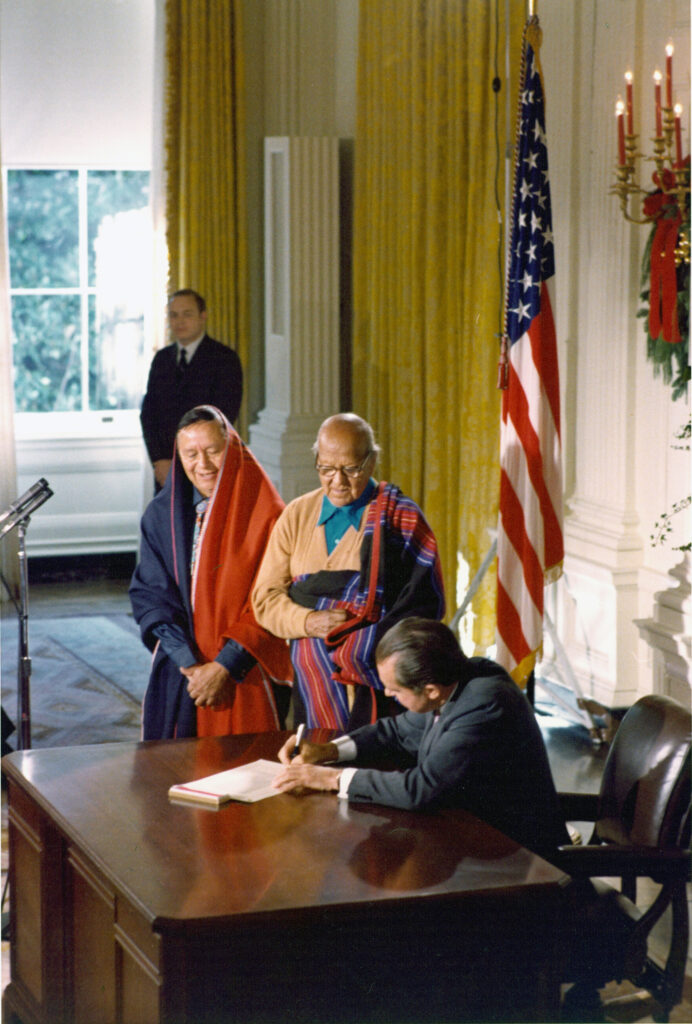
President Richard Nixon signs the Blue Lake bill on December 15, 1970, with Taos Pueblo representatives present. Credit: White House Photo Office / Richard Nixon Presidential Library and Museum, NARA. Original source. Public domain: official U.S. government photograph.
WASHINGTON, Dec. 16.—President Nixon yesterday signed the measure returning Blue Lake and surrounding land to Taos Pueblo. The action gives a concrete land decision to the administration’s announced policy of encouraging Indian self-determination without requiring an eventual end to the federal relationship.
Blue Lake holds religious importance for Taos Pueblo. Its return concerns the authority of a living community to protect a place central to its own life. It cannot be fully described as the transfer of a recreational site or a parcel with a market value.
In his July 8 message to Congress, the President rejected termination as a basis for Indian policy and called for a greater Indian role in administering programs. Yesterday’s legislation concerns approximately forty-eight thousand acres and answers a particular, long-standing Pueblo demand.
One land return does not restore every community’s property or discharge every federal obligation. Its significance lies in what the government has agreed to do in this case, and in the principle that Native people should have a decisive part in determining their future.
For Southern California tribes, the administration’s policy will be tested through their own land, service and jurisdiction questions. Taos Pueblo’s religious and legal circumstances are specific. Their importance does not depend on treating all Native nations as having the same claim.
A policy statement can be reconsidered by another administration. A law changes the legal terms of a particular matter. The next task is to examine both: how this return is carried out, and whether self-determination becomes a working practice in federal dealings beyond this ceremony.
Explore the Story
Sources & further reading.
Related Herald reporting
- Alcatraz Occupation Ends; the Questions It Raised Remain on the Mainland — Thomas Navarro, 1971-06-12.
- Indian Health Council Begins With Local Work and a Claim to Better Care — Thomas Navarro, 1970-12-20.
- San Diego Tribal Chairmen Establish a Common Working Association — Katherine “Kate” Romero, 1972-12-10.
- Indian Civil Rights Act Sets Individual Protections Within Tribal Government — Thomas Navarro, 1968-04-12.
- California Indian Legal Services Builds a Practice Around Tribal Rights — Thomas Navarro, 1967-12-17.
- Rincon Appeal Ends on a Jurisdiction Question, Leaving County Authority Unsettled — Katherine “Kate” Romero, 1974-06-16.
- Section 14 Places Palm Springs’ Growth Beside the Cost of Displacement — Thomas Navarro, 1966-12-18.
- New Law Offers Tribes a Greater Role in Running Federal Programs — Katherine “Kate” Romero, 1975-01-05.
- Agua Caliente’s Women Leaders Press for Control of Their Land’s Future — William Keane, 1959-12-13.
- California Rancheria Law Sets Conditions for Ending Federal Trust Relations — Joan Mercer, 1958-08-19.
- New Law Extends California’s Court Jurisdiction Into Indian Country — William Keane, 1953-08-16.
- Congress Announces a Policy of Ending Federal Supervision of Indian Tribes — Edward Hensley, 1953-08-02.
- New Indian Law Halts Allotment and Opens a Different Course for Tribal Government — Samuel Voss, 1934-06-19.
- Native Students Press UCLA to Make Their History Part of the University — Thomas Navarro, 1969-12-07.
Join the conversation