

The Aeon Herald / HISTORICAL EDITION
Federal Review Finds Serious Failures in Sterilization Consent Procedures
A GAO investigation documents deficiencies in Indian Health Service practices and calls for stronger safeguards, while leaving individual experiences incompletely examined.
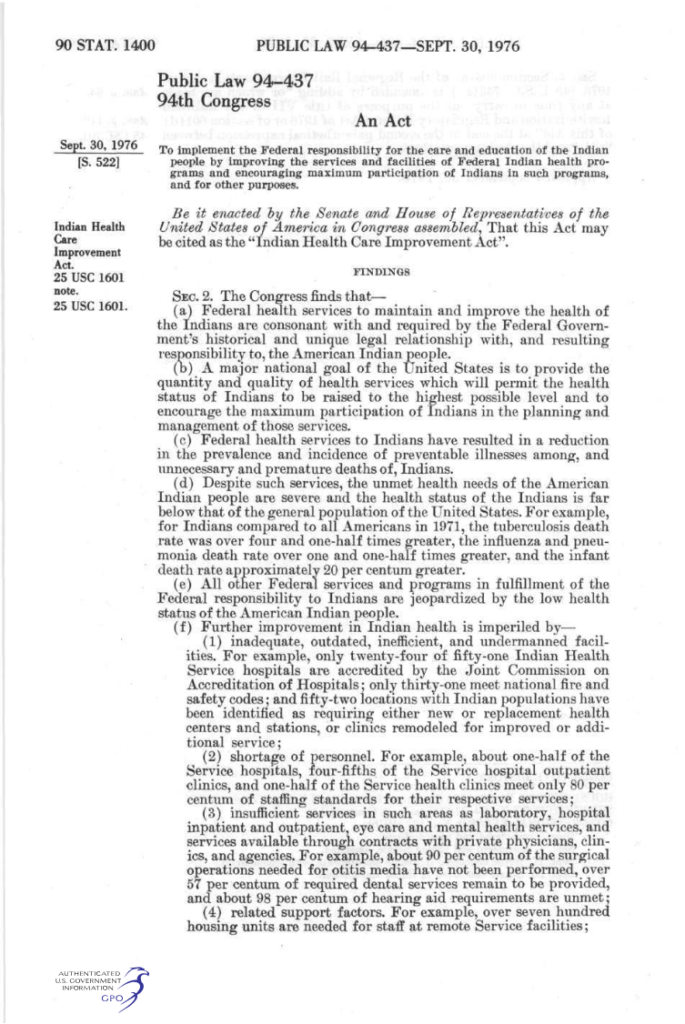
The Indian Health Care Improvement Act, signed September 30, 1976, reproduced from the U.S. Statutes at Large. This health-policy document provides context; it is not the November GAO investigation or a patient record. Credit: U.S. Congress / Government Publishing Office, GovInfo. Original source. Public domain: official U.S. federal government publication and statutory text. Public domain.
WASHINGTON, Nov. 7.—A General Accounting Office investigation has found serious deficiencies in the procedures intended to secure informed consent for sterilization at Indian Health Service facilities and associated contract facilities. The report, issued November 4, places federal oversight of permanent medical procedures before Congress with demands for corrective action.
The review covered four service areas: Aberdeen, Albuquerque, Oklahoma City and Phoenix. Records for fiscal 1973 through fiscal 1976 identified 3,406 sterilization procedures involving women; the report notes that the contract-case figures for 1976 cover only ten months. That total describes the procedures identified, not a finding that every woman in the count lacked consent.
The documented failures remain grave. The report found inadequate consent documentation and procedures that did not comply with governing requirements. It also identified operations on patients under twenty-one despite the moratorium applying to that age group.
Investigators did not interview the sterilized patients to establish what each had understood before the procedure. That limitation must remain beside the findings. A deficient form, a woman’s experience of pressure and a fully investigated individual case are related matters, but they are not interchangeable evidence.
The basic requirement is plain: a patient must receive understandable information about a permanent operation, alternatives and the freedom to decline without losing benefits. A signature cannot be treated as an adequate answer when the conditions necessary for a free decision are missing.
Native women and advocates have pressed for scrutiny of these practices. The work now requires safeguards that operate in the examining room, oversight of contract care and a hearing for women describing what happened to them. Correcting paperwork alone cannot restore a choice already taken away.
Explore the Story
Sources & further reading.
Related Herald reporting
- New Law Offers Tribes a Greater Role in Running Federal Programs — Katherine “Kate” Romero, 1975-01-05.
- Rincon Clinic Opening Marks Years of Work Toward Native-Directed Care — Katherine “Kate” Romero, 1976-12-12.
- Indian Child Welfare Act Sets Standards Against the Breakup of Native Families — Katherine “Kate” Romero, 1978-11-09.
- On Winston Street, Native Women Build a Place to Turn — Katherine “Kate” Romero, 1974-12-15.
- Women of All Red Nations Connect Health, Family and Political Survival — Katherine “Kate” Romero, 1978-12-10.
- San Diego’s Native Community Establishes an Urban Health Center — Katherine “Kate” Romero, 1979-12-09.
- Indian Health Council Begins With Local Work and a Claim to Better Care — Thomas Navarro, 1970-12-20.
- Rincon Appeal Ends on a Jurisdiction Question, Leaving County Authority Unsettled — Katherine “Kate” Romero, 1974-06-16.
Join the conversation