

The Aeon Herald / HISTORICAL EDITION
New Law Offers Tribes a Greater Role in Running Federal Programs
The Indian Self-Determination and Education Assistance Act establishes a contracting framework while retaining federal responsibilities.
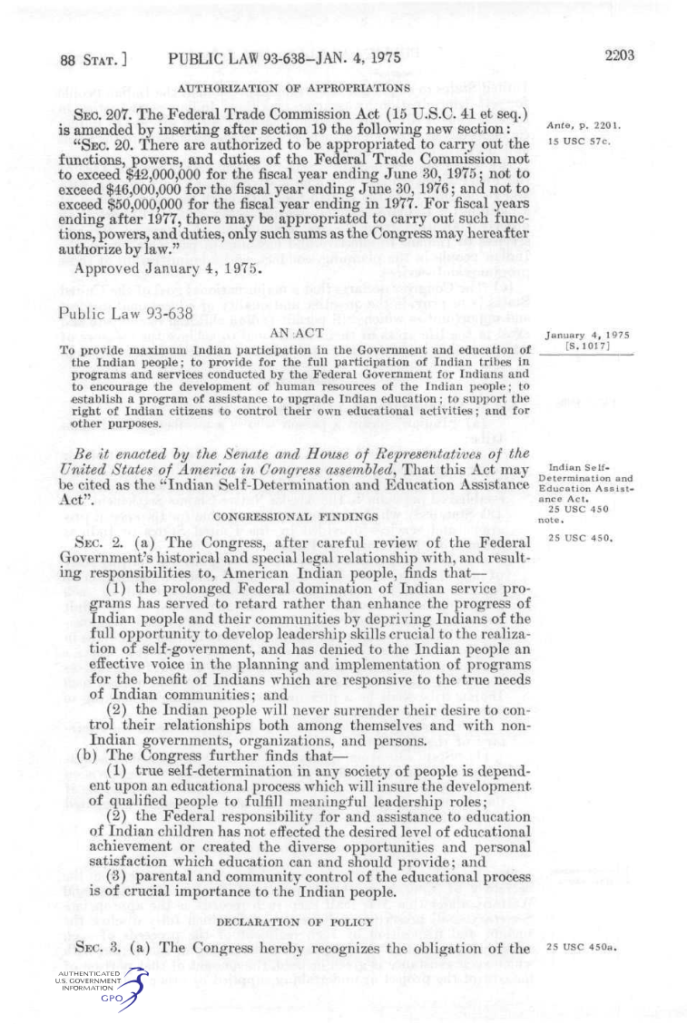
Facsimile from the Indian Self-Determination and Education Assistance Act, January 4, 1975, reproduced from the U.S. Statutes at Large. The original statutory page is shown without alteration. Credit: U.S. Congress / Government Publishing Office, GovInfo. Original source. Public domain: official U.S. federal government publication and statutory text. Public domain.
WASHINGTON, Jan. 5.—President Ford yesterday signed the Indian Self-Determination and Education Assistance Act, establishing a framework through which tribes can take a greater role in administering programs serving their communities. The law addresses education and services while rejecting the assumption that effective administration must remain entirely in outside hands.
The act provides for contracts under which tribal organizations may carry out specified federal programs and services. The change concerns who conducts the work and how the community participates in decisions. It does not mean that every federal obligation has ended or that every program automatically passes to tribal control.
For a parent or patient, the significance may appear in the ordinary operation of a school or service office. A program shaped near the people it serves may recognize needs an agency at a distance has overlooked. That possibility depends on authority being accompanied by usable resources.
Contract terms, funding and administrative requirements will therefore deserve close scrutiny. A new responsibility can be made ineffective if the institution receiving it lacks the means to perform it. Participation cannot be measured solely by the transfer of a file or the signature on an agreement.
The legislation also needs to be understood against termination. Native communities have demanded a role in their own affairs without being told that taking responsibility requires surrendering the federal relationship. The act responds to that distinction in a concrete statutory form.
Southern California organizations already working in education and health will be among those following implementation. Their experience can help test the law’s promise: whether self-determination becomes an effective practice in the provision of services, with the government remaining accountable for the commitments it has made.
Explore the Story
Sources & further reading.
Related Herald reporting
- Rincon Appeal Ends on a Jurisdiction Question, Leaving County Authority Unsettled — Katherine “Kate” Romero, 1974-06-16.
- Federal Review Finds Serious Failures in Sterilization Consent Procedures — Katherine “Kate” Romero, 1976-11-07.
- Rincon Clinic Opening Marks Years of Work Toward Native-Directed Care — Katherine “Kate” Romero, 1976-12-12.
- Blue Lake Return Gives Land to a Policy of Self-Determination — Thomas Navarro, 1970-12-16.
- Indian Civil Rights Act Sets Individual Protections Within Tribal Government — Thomas Navarro, 1968-04-12.
- California Indian Legal Services Builds a Practice Around Tribal Rights — Thomas Navarro, 1967-12-17.
- Section 14 Places Palm Springs’ Growth Beside the Cost of Displacement — Thomas Navarro, 1966-12-18.
- Agua Caliente’s Women Leaders Press for Control of Their Land’s Future — William Keane, 1959-12-13.
- California Rancheria Law Sets Conditions for Ending Federal Trust Relations — Joan Mercer, 1958-08-19.
- New Law Extends California’s Court Jurisdiction Into Indian Country — William Keane, 1953-08-16.
- Congress Announces a Policy of Ending Federal Supervision of Indian Tribes — Edward Hensley, 1953-08-02.
- New Indian Law Halts Allotment and Opens a Different Course for Tribal Government — Samuel Voss, 1934-06-19.
- On Winston Street, Native Women Build a Place to Turn — Katherine “Kate” Romero, 1974-12-15.

Join the conversation