

The Aeon Herald / HERALD ORIGINAL
ʻOumuamua’s Small Extra Acceleration Favors a Cometary Explanation
Measurements show a departure from gravity-only motion; escaping gas is the research team’s explanation, although the visitor never displayed an ordinary dusty tail.
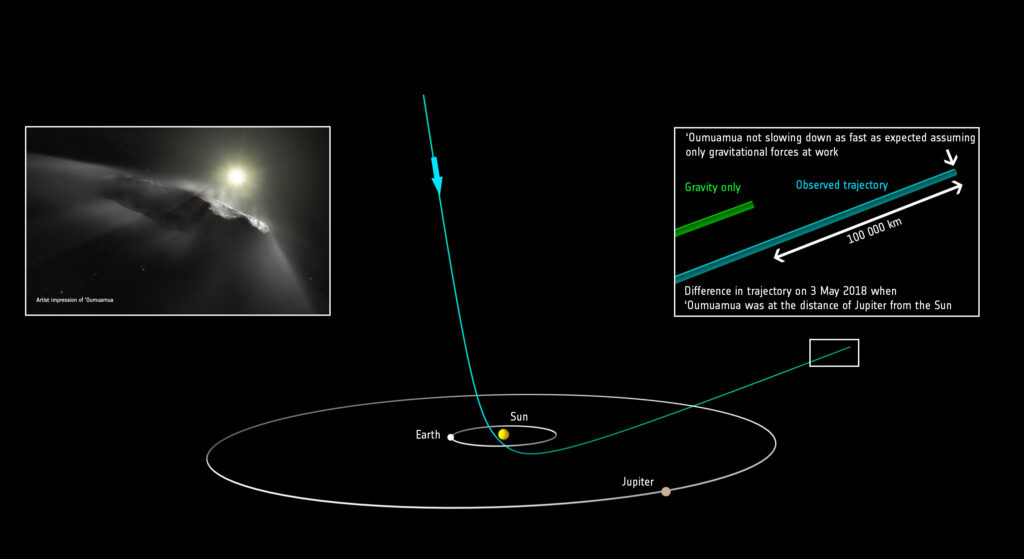
This 2018 chart compares the measured path of ʻOumuamua with the path predicted by gravity alone. The inset at left is an artist’s impression. ESA, CC BY 4.0. Image source · CC BY 4.0 under ESO's explicit distribution policy, including captioned third-party credits absent an exception.
The first recognized interstellar visitor, ʻOumuamua, has supplied astronomers with another puzzle: a small acceleration that cannot be explained by the gravitational calculation alone. A study published Wednesday in Nature finds that the object’s outbound motion fits an additional push of the kind produced when a comet releases gas.
The result comes from positions measured by ground observatories and the Hubble Space Telescope after the object’s October 2017 discovery. By January 2, the accumulated difference from a gravity-only prediction amounted to about 40,000 kilometers along its path. That is a displacement in the calculated position, not a sudden burst of 40,000 kilometers per hour in speed.
Gas escaping from sun-warmed material can act like a weak thruster. The research team regards that process as the most plausible explanation for the motion. The difficulty is that ʻOumuamua did not show the familiar cloud of dust and tail by which a comet ordinarily announces such activity. A shortage of small dust grains could make the gas release much less conspicuous.
The object’s shape also remains indirect evidence. It was never resolved as a detailed surface in the available telescopes. Strong, repeating brightness changes as it tumbled suggest a highly elongated body, but the illustrations accompanying the research are models of a possible appearance, not spacecraft photographs.
The visitor has now faded beyond the reach of even the telescopes used in the campaign. The final observations must therefore carry much of the burden of interpretation. Researchers can compare physical explanations against its trajectory and light changes, but cannot obtain the kind of close inspection available for a Solar System target selected years before a mission.
The new paper strengthens a cometary interpretation without supplying every missing detail about composition or activity. An unexplained term in an orbit is a reason to test physical causes; it is not evidence by itself of machinery or a threat to Earth. ʻOumuamua’s importance remains its origin beyond the Solar System and the brief opportunity it has given astronomers to study material arriving from elsewhere.
Sources & further reading
- Our Solar System’s First Known Interstellar Object Gets Unexpected Speed Boost — NASA; June 27, 2018.
- Non-gravitational acceleration in the trajectory of 1I/2017 U 1 (ʻOumuamua) — Marco Micheli and colleagues / Nature; June 27, 2018 online; July 12 print issue.
- Chasing ʻOumuamua — NASA/JPL-Caltech; June 27, 2018.
Related Herald reporting
- An Object From Another Star System Passes Through Ours — Eric Bennett, 2017-11-21.
- Third Interstellar Visitor Follows a Safe Route Through the Solar System — Sarah Nguyen, 2025-07-05.
- Seven Dyson Sphere Candidates Face a Test of What Lies Behind Them — Sarah Nguyen, 2024-05-24.
HERALD ORIGINAL

Join the conversation