

The Aeon Herald / HISTORICAL EDITION
California Indian Legal Services Builds a Practice Around Tribal Rights
A new legal organization concentrates on the distinct land, jurisdiction and government questions facing California Indian communities.
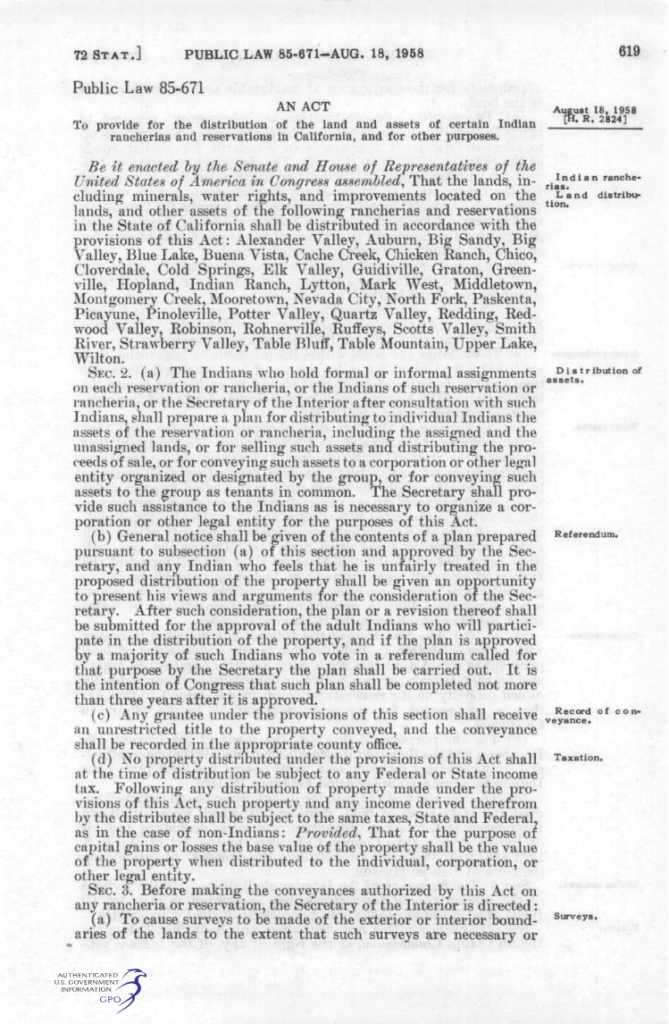
The California Rancheria Act of August 18, 1958, reproduced from the U.S. Statutes at Large. This earlier law supplies context for the complex federal and state issues confronting Native legal advocates; the CILS office is not pictured. Credit: U.S. Congress / Government Publishing Office, GovInfo. Original source. Public domain: official U.S. federal government publication and statutory text. Public domain.
CALIFORNIA, Dec. 17.—California Indian Legal Services has been established to concentrate legal work on the problems facing the state’s Native communities. Its creation recognizes that reservation land, tribal government and federal obligations require knowledge beyond the ordinary handling of a local civil dispute.
George Duke and David Risling, a Hoopa Valley organizer, have been central to the effort. The organization developed from work serving rural clients and has taken a separate institutional form this year. Its purpose is to give Indian clients access to advocates able to address the particular legal setting of their cases.
The distinction can determine how a problem is framed. A dispute that appears to concern a county permit may also involve the limits of state jurisdiction. The loss of a service may be connected to termination legislation. An apparently private property question may concern land held in trust.
A client should not have to discover those connections alone. Legal assistance can bring the applicable law into the room before a decision is made, rather than after a deadline has passed or property has been lost.
Southern California communities have their own circumstances and priorities. The existence of a statewide organization does not make every reservation’s legal history identical. Effective representation will require listening to the clients and determining which facts and authorities actually govern their situation.
The formation of the service is therefore an institutional story as well as a legal one. Sustained advocacy requires trained people, records and continuing relationships. Those less visible resources may decide whether a right can be defended when an official or private interest challenges it.
Explore the Story
Sources & further reading.
Related Herald reporting
- Voting Rights Act Gives Federal Force to the Fight Against Racial Exclusion — Thomas Navarro, 1965-08-07.
- Indian Civil Rights Act Sets Individual Protections Within Tribal Government — Thomas Navarro, 1968-04-12.
- American Indian Movement Begins With the Needs of Native City Residents — Thomas Navarro, 1968-12-22.
- Section 14 Places Palm Springs’ Growth Beside the Cost of Displacement — Thomas Navarro, 1966-12-18.
- Blue Lake Return Gives Land to a Policy of Self-Determination — Thomas Navarro, 1970-12-16.
- Rincon Appeal Ends on a Jurisdiction Question, Leaving County Authority Unsettled — Katherine “Kate” Romero, 1974-06-16.
- New Law Offers Tribes a Greater Role in Running Federal Programs — Katherine “Kate” Romero, 1975-01-05.
- Agua Caliente’s Women Leaders Press for Control of Their Land’s Future — William Keane, 1959-12-13.
- California Rancheria Law Sets Conditions for Ending Federal Trust Relations — Joan Mercer, 1958-08-19.
- New Law Extends California’s Court Jurisdiction Into Indian Country — William Keane, 1953-08-16.
- Congress Announces a Policy of Ending Federal Supervision of Indian Tribes — Edward Hensley, 1953-08-02.
- New Indian Law Halts Allotment and Opens a Different Course for Tribal Government — Samuel Voss, 1934-06-19.
- Fishing Families Put Treaty Promises on the Riverbank — Thomas Navarro, 1964-03-08.
Join the conversation