

The Aeon Herald / HISTORICAL EDITION
New Law Extends California’s Court Jurisdiction Into Indian Country
Public Law 280 transfers important criminal and civil jurisdiction to California, bringing new questions for reservation residents and tribal governments.
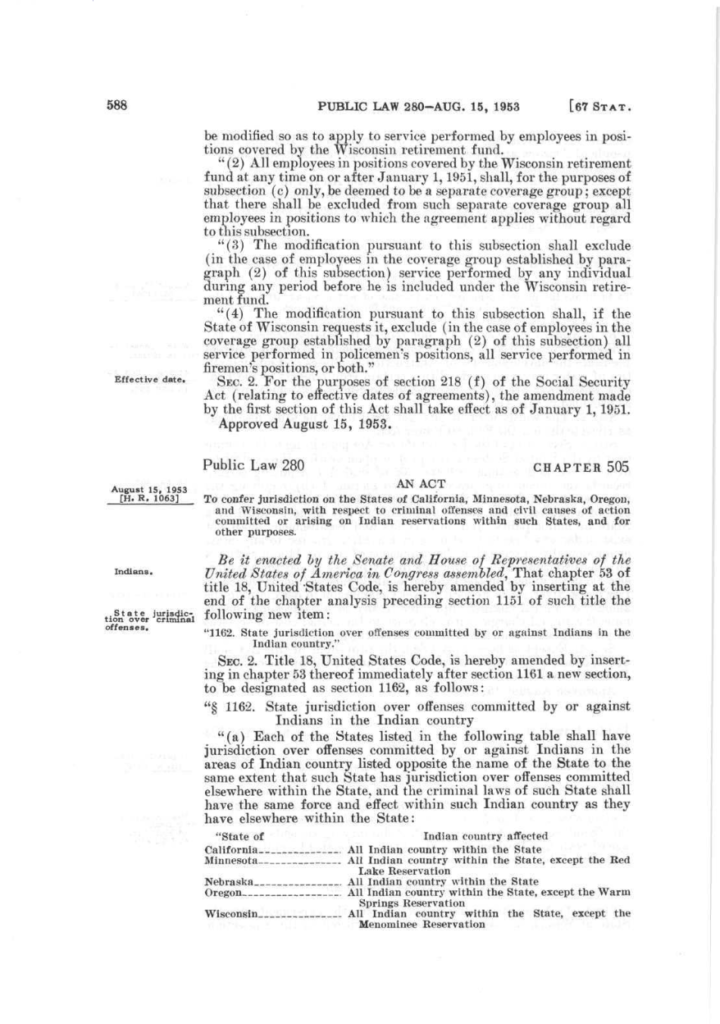
Facsimile from the Public Law 83-280, August 15, 1953, reproduced from the U.S. Statutes at Large. The original statutory page is shown without alteration. Credit: U.S. Congress / Government Publishing Office, GovInfo. Original source. Public domain: official U.S. federal government publication and statutory text. Public domain.
SOUTHERN CALIFORNIA, Aug. 16.—A federal law signed yesterday extends California’s criminal jurisdiction and jurisdiction over civil causes involving Indians in Indian country. Public Law 280 places new responsibility in state institutions and changes the legal setting in which reservation residents must deal with courts and law-enforcement officers.
California is among the states specified in the act. The statute sets out criminal jurisdiction and provisions concerning civil disputes, while preserving stated protections for trust property and certain rights arising from federal law and treaties.
Those qualifications matter. The law should not be read as a simple declaration that every state or county regulation now applies on every reservation. Different kinds of authority are involved, and the text does not erase the federal protections it expressly preserves.
For a resident, the immediate questions can be practical: which officer answers a complaint, which court hears a dispute, and whether officials understand the legal position of the land and people before them. A transfer on paper will have little value if responsibility is passed from one office to another without service.
For tribal government, the change reaches into an existing relationship with the United States. Decisions about jurisdiction affect the exercise of community authority as well as the handling of a particular case. The new arrangement warrants explanations from the agencies expected to administer it.
Local reporting should follow those explanations carefully. Public Law 280 is a dated and specific enactment, not a phrase that can answer every future controversy. Its application will need to be examined case by case, with tribal residents heard alongside county officials.
Explore the Story
Sources & further reading.
Related Herald reporting
- Congress Announces a Policy of Ending Federal Supervision of Indian Tribes — Edward Hensley, 1953-08-02.
- Agua Caliente’s Women Leaders Press for Control of Their Land’s Future — William Keane, 1959-12-13.
- The Federal Relocation Promise Meets the Cost of Living in Los Angeles — Lillian Marsh, 1956-08-12.
- California Rancheria Law Sets Conditions for Ending Federal Trust Relations — Joan Mercer, 1958-08-19.
- Section 14 Places Palm Springs’ Growth Beside the Cost of Displacement — Thomas Navarro, 1966-12-18.
- California Indian Legal Services Builds a Practice Around Tribal Rights — Thomas Navarro, 1967-12-17.
- Indian Civil Rights Act Sets Individual Protections Within Tribal Government — Thomas Navarro, 1968-04-12.
- Blue Lake Return Gives Land to a Policy of Self-Determination — Thomas Navarro, 1970-12-16.
- New Indian Law Halts Allotment and Opens a Different Course for Tribal Government — Samuel Voss, 1934-06-19.
- Rincon Appeal Ends on a Jurisdiction Question, Leaving County Authority Unsettled — Katherine “Kate” Romero, 1974-06-16.
- New Law Offers Tribes a Greater Role in Running Federal Programs — Katherine “Kate” Romero, 1975-01-05.
- Indian Voters Win Court Rulings in Arizona and New Mexico — Samuel Voss, 1948-08-08.
Join the conversation