

The Aeon Herald / HISTORICAL EDITION
Women of All Red Nations Connect Health, Family and Political Survival
Native women’s organizing brings reproductive autonomy and community well-being into the center of the rights struggle.
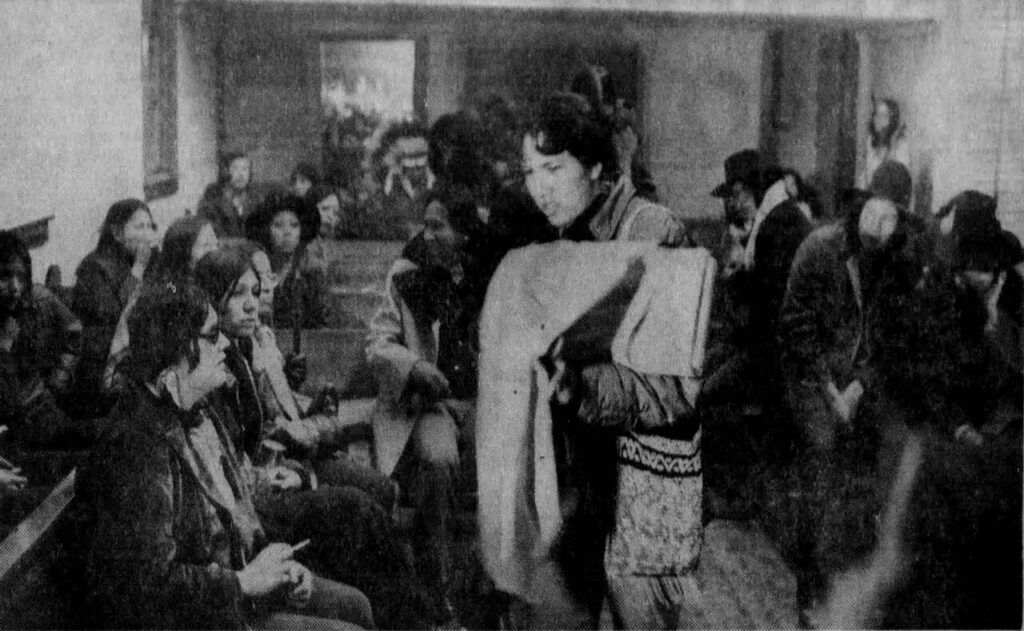
A woman displays a cloth inside the Wounded Knee church, February 27, 1973. Earlier context for women’s participation in Native activism; this is not a photograph of a Women of All Red Nations meeting. Credit: Walter Fisk / Rapid City Journal, March 1, 1973, via Wikimedia Commons. Original source. Public domain in the United States: 1973 newspaper publication without copyright notice, as documented in the Commons record.
CALIFORNIA, Dec. 10.—Women organizing through Women of All Red Nations are pressing a broad account of Native rights, connecting health and family life with the survival of their communities. Their work makes visible leadership that has sustained the movement through its public confrontations and its quieter daily obligations.
Lorelei DeCora Means, Madonna Thunder Hawk, Phyllis Young and Janet McCloud are among the women associated with the organization. Their concerns include reproductive autonomy, treaty rights and the conditions in which Native children will grow up.
The federal investigation of Indian Health Service sterilization practices has given particular urgency to demands for informed consent and accountability. A medical decision can have permanent consequences for a woman and her family. The authority to decide must remain with the patient, supported by understandable information and freedom from pressure.
The organizing also brings women’s political work into view on its own terms. Care, education and maintaining a community are subjects of public power. They cannot be dismissed as matters outside the movement while government agencies make decisions affecting them.
Participation does not mean agreement on every strategy. Native women come from different nations, generations and experiences. An organization can create a place to compare those experiences and coordinate action without requiring a single account of womanhood or community life.
For a reporter, the assignment is to follow the specific work: a complaint brought forward, a policy challenged, a meeting sustained after attention has shifted elsewhere. The measure of leadership is also found there, in the capacity to keep a claim alive until an institution must answer it.
Explore the Story
Sources & further reading.
Related Herald reporting
- Court Affirms Treaty Tribes’ Share of Washington Fisheries — Katherine “Kate” Romero, 1974-02-13.
- On Winston Street, Native Women Build a Place to Turn — Katherine “Kate” Romero, 1974-12-15.
- Rincon Appeal Ends on a Jurisdiction Question, Leaving County Authority Unsettled — Katherine “Kate” Romero, 1974-06-16.
- San Diego’s Native Community Establishes an Urban Health Center — Katherine “Kate” Romero, 1979-12-09.
- Rincon Clinic Opening Marks Years of Work Toward Native-Directed Care — Katherine “Kate” Romero, 1976-12-12.
- Federal Review Finds Serious Failures in Sterilization Consent Procedures — Katherine “Kate” Romero, 1976-11-07.
- Indian Health Council Begins With Local Work and a Claim to Better Care — Thomas Navarro, 1970-12-20.
- Brando’s Oscar Refusal Brings Hollywood’s Indian Image Before Its Own Audience — Katherine “Kate” Romero, 1973-03-28.

Join the conversation