

The Aeon Herald / HISTORICAL EDITION
Court Affirms Treaty Tribes’ Share of Washington Fisheries
Judge George Boldt’s ruling places treaty obligations at the center of fishing regulation after years of arrests and protest.
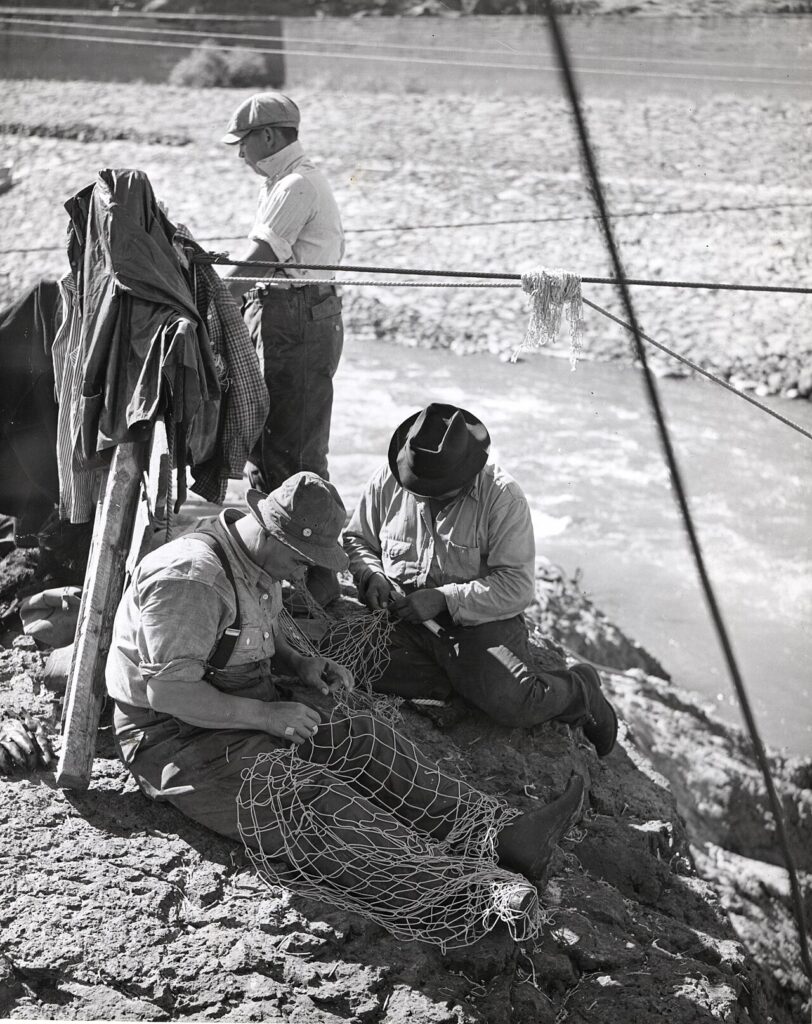
Native salmon fishermen repair their nets at Celilo Falls, Oregon, circa 1950. This earlier Columbia River photograph illustrates the work behind fishing-rights disputes; it does not depict a Washington fish-in or the Boldt proceedings. Credit: NOAA Historic Fisheries Collection, fish5711; photographer uncredited. Original source. Public domain: NOAA photograph, Commons PD-US-NOAA record.
TACOMA, Wash., Feb. 13.—A federal court ruling yesterday affirmed treaty fishing rights in Washington and set a major new basis for dividing the harvest. Judge George Boldt’s decision in United States v. Washington recognizes the treaty tribes’ right to a share of harvestable fish at their usual and accustomed fishing places.
The decision interprets the treaties’ promise of fishing in common with other citizens as an entitlement to an equal share, subject to the terms of the ruling. The allocation concerns the harvestable resource at the tribes’ usual and accustomed fishing places.
For fishing families, the judgment follows years in which a trip to the river could bring an arrest. The fish-ins made those conflicts visible to a national audience. The court has now addressed obligations whose meaning the families have insisted should guide public authority.
The decision also changes the work of fisheries management. Determining runs, protecting the resource and carrying out an allocation require continuing cooperation and enforcement. A legal right must be made effective in the season when a family needs to fish.
Opposition to the ruling will be part of the story, but objections cannot erase the treaties from the account. Conservation and livelihood are both serious matters. They must be discussed within the legal relationship the United States established with the tribes.
The judgment is specific to the treaties and fisheries before the court. Southern California communities have different legal histories. What travels beyond Washington is the requirement that an old promise be examined as an operative obligation, with consequences for the conduct of government today.
Explore the Story
Sources & further reading.
Related Herald reporting
- Brando’s Oscar Refusal Brings Hollywood’s Indian Image Before Its Own Audience — Katherine “Kate” Romero, 1973-03-28.
- Women of All Red Nations Connect Health, Family and Political Survival — Katherine “Kate” Romero, 1978-12-10.
- On Winston Street, Native Women Build a Place to Turn — Katherine “Kate” Romero, 1974-12-15.
- Wounded Knee Occupation Ends After Seventy-One Days — Katherine “Kate” Romero, 1973-05-09.
- Trail of Broken Treaties Brings Twenty Demands Into Washington — Katherine “Kate” Romero, 1972-11-10.
- Alcatraz Occupation Ends; the Questions It Raised Remain on the Mainland — Thomas Navarro, 1971-06-12.
- Longest Walk Reaches Washington With Treaty Rights at Its Center — Katherine “Kate” Romero, 1978-07-23.
- American Indian Movement Begins With the Needs of Native City Residents — Thomas Navarro, 1968-12-22.
- Native Delegates Bring Treaties and Sovereignty to the Poor People’s Campaign — Thomas Navarro, 1968-06-20.
- Fishing Families Put Treaty Promises on the Riverbank — Thomas Navarro, 1964-03-08.
- A Younger Generation Organizes to Speak for Itself — Thomas Navarro, 1961-09-03.
- Tribal Delegates Form a National Congress to Defend Their Rights — Edward Hensley, 1944-11-19.

Join the conversation