

The Aeon Herald / HISTORICAL EDITION
Brando’s Oscar Refusal Brings Hollywood’s Indian Image Before Its Own Audience
Sacheen Littlefeather appears in Brando’s place, turning the awards ceremony toward screen representation and Wounded Knee.
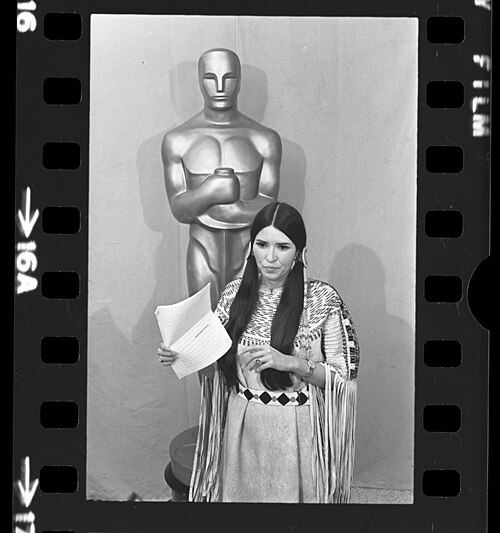
Sacheen Littlefeather holds Marlon Brando’s statement at the 45th Academy Awards in Los Angeles, March 27, 1973. Credit: Rick Browne / Los Angeles Times Photographic Collection, UCLA Library Special Collections. Original source. CC BY 4.0; UCLA holds the collection copyright and releases this image under that license. Unaltered apart from web sizing. CC BY 4.0.
LOS ANGELES, Mar. 28.—Marlon Brando’s refusal of the Academy Award for best actor interrupted Hollywood’s familiar account of itself last night. Appearing in his place, Sacheen Littlefeather declined the award on his behalf and directed attention to the treatment of American Indians in film and to the confrontation at Wounded Knee.
The 45th Academy Awards also named The Godfather best picture. Bob Fosse received the directing award for Cabaret, whose Liza Minnelli and Joel Grey won leading actress and supporting actor. Eileen Heckart received supporting actress for Butterflies Are Free. Cabaret collected eight competitive awards; The Godfather received three, including Brando’s award and adapted screenplay.
Brando won for his performance in The Godfather. His absence and the appearance of a representative made the acceptance itself the news. The audience’s mixed response exposed a division that an ordinary tribute to an actor would have left out of view.
The protest concerns the industry’s power to make an image appear natural through repetition. A familiar screen figure can flatten different Native peoples into one role, detach them from contemporary life and assign them a place in somebody else’s adventure.
That question is particularly close to a Los Angeles newspaper. Film is made here by people working within institutions that can decide who receives a role, whose account is financed and which objections are heard. An argument about representation therefore includes employment and creative authority as well as the finished picture.
The mention of Wounded Knee brought an ongoing political confrontation into the ceremony. It also showed how little room a broadcast interruption provides for explaining the underlying history. Viewers deserve reporting that follows the reference beyond the moment on stage.
Last night’s refusal will be debated as conduct at an awards show. Its larger challenge asks what the industry is prepared to hear from the people it depicts. That discussion should include Native actors, writers and audiences, with their different judgments given room to be expressed.
Explore the Story
Sources & further reading.
Sources & further reading
Related Herald reporting
- Wounded Knee Occupation Ends After Seventy-One Days — Katherine “Kate” Romero, 1973-05-09.
- Court Affirms Treaty Tribes’ Share of Washington Fisheries — Katherine “Kate” Romero, 1974-02-13.
- Women of All Red Nations Connect Health, Family and Political Survival — Katherine “Kate” Romero, 1978-12-10.
- The French Connection Wins Five at the 44th Oscars — Denise Whitfield, 1972-04-11.
- The Sting Leads the 46th Academy Awards with Seven Wins — Denise Whitfield, 1974-04-03.
- Indian Education Act Opens a Greater Place for Parents and Community Priorities — Katherine “Kate” Romero, 1972-06-25.
- An Unclothed Intruder Interrupts the Academy’s Best-Picture Introduction — Denise Whitfield, 1974-04-03.
Join the conversation