

The Aeon Herald / HISTORICAL EDITION
Wounded Knee Occupation Ends After Seventy-One Days
The end of the standoff leaves Oglala grievances, deaths and the conduct of government authority demanding sustained attention.
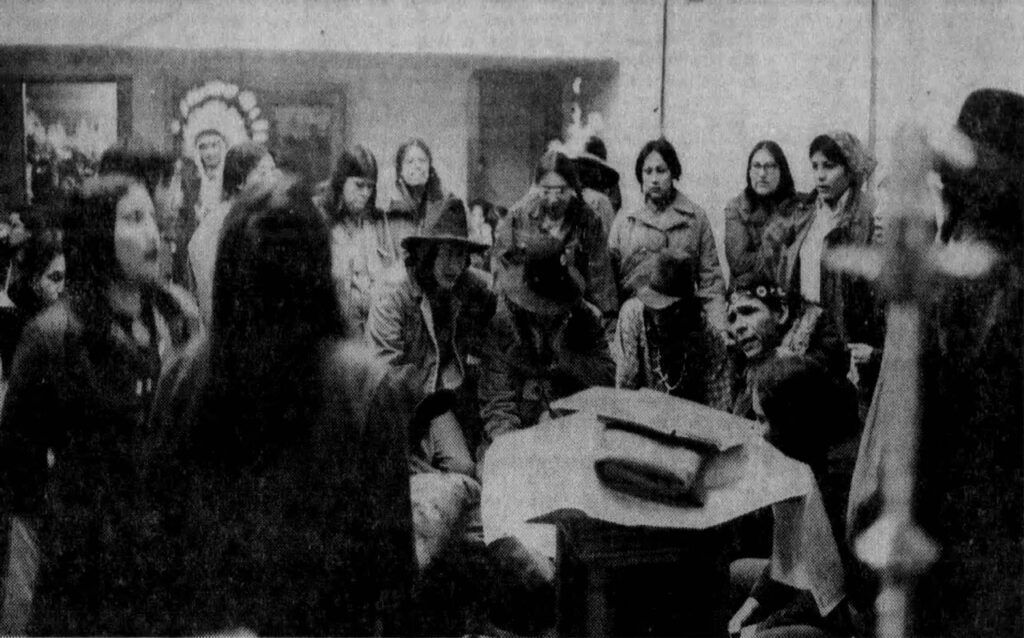
Dennis Banks, seated at right, speaks inside the Wounded Knee church on February 27, 1973, at the beginning of the occupation. Credit: Walter Fisk / Rapid City Journal, March 1, 1973, via Wikimedia Commons. Original source. Public domain in the United States: 1973 newspaper publication without copyright notice, as documented in the Commons record.
PINE RIDGE RESERVATION, S.D., May 9.—The occupation of Wounded Knee ended yesterday after seventy-one days, closing a confrontation that brought armed Native activists and federal officers into a prolonged standoff. The settlement ends the occupation. It leaves the grievances that brought people here, and the deaths and injuries of the intervening weeks, in need of a fuller accounting.
Oglala opponents of the tribal administration sought attention to local conditions and the conduct of authority. American Indian Movement members joined the occupation, which began February 27. The local conflict and the movement’s broader demands became connected, but they were not identical matters.
Two Native men, Frank Clearwater and Lawrence Lamont, died during the confrontation. Federal officers were also wounded. Reporting those losses requires care with the sequence of events and with the claims made by different parties; an allegation does not become an established finding through repetition.
From the approaches to Wounded Knee, a reporter encounters the limits imposed by roadblocks, official statements and interrupted access. Those limits should remain visible in the account. No single vantage point supplies everything that occurred inside the village or along its perimeter.
Women’s work in organizing, care and maintaining the occupation belongs in the record alongside its public spokesmen. Residents also experienced fear, divided loyalties and losses that cannot be explained by treating the reservation as the backdrop to a national demonstration.
The next assignment is to follow the terms of the settlement, the investigations and the continuing claims of Oglala residents. Wounded Knee has commanded national attention. That attention should now reach the decisions and conditions that existed before the cameras arrived.
Explore the Story
Sources & further reading.
Related Herald reporting
- Indian Education Act Opens a Greater Place for Parents and Community Priorities — Katherine “Kate” Romero, 1972-06-25.
- Brando’s Oscar Refusal Brings Hollywood’s Indian Image Before Its Own Audience — Katherine “Kate” Romero, 1973-03-28.
- Court Affirms Treaty Tribes’ Share of Washington Fisheries — Katherine “Kate” Romero, 1974-02-13.
- Trail of Broken Treaties Brings Twenty Demands Into Washington — Katherine “Kate” Romero, 1972-11-10.
- Alcatraz Occupation Ends; the Questions It Raised Remain on the Mainland — Thomas Navarro, 1971-06-12.
- American Indian Movement Begins With the Needs of Native City Residents — Thomas Navarro, 1968-12-22.
- Native Delegates Bring Treaties and Sovereignty to the Poor People’s Campaign — Thomas Navarro, 1968-06-20.
- Longest Walk Reaches Washington With Treaty Rights at Its Center — Katherine “Kate” Romero, 1978-07-23.
- Fishing Families Put Treaty Promises on the Riverbank — Thomas Navarro, 1964-03-08.
- A Younger Generation Organizes to Speak for Itself — Thomas Navarro, 1961-09-03.
- Tribal Delegates Form a National Congress to Defend Their Rights — Edward Hensley, 1944-11-19.
Join the conversation