

The Aeon Herald / HISTORICAL EDITION
Indian Education Act Opens a Greater Place for Parents and Community Priorities
A new federal education title recognizes the particular needs of Indian children and includes a role for parent participation.
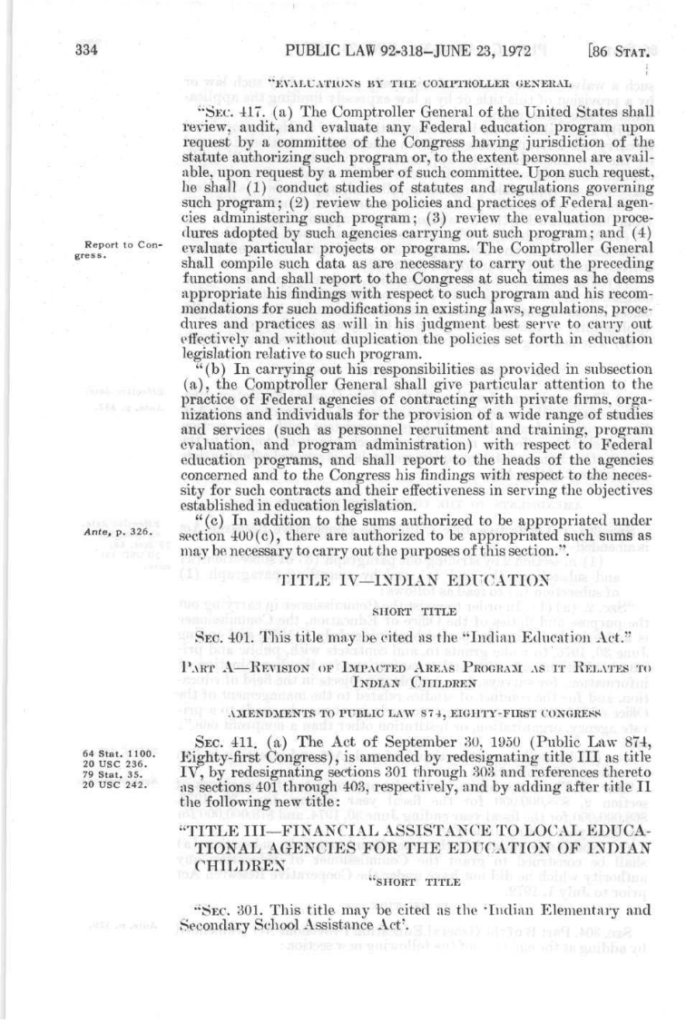
Facsimile from the Indian Education Act provisions, June 23, 1972, reproduced from the U.S. Statutes at Large (PDF page 100). The original statutory page is shown without alteration. Credit: U.S. Congress / Government Publishing Office, GovInfo. Original source. Public domain: official U.S. federal government publication and statutory text. Public domain.
WASHINGTON, June 25.—The education legislation signed Friday includes an Indian Education Act establishing assistance directed toward the needs of Indian children. The measure places those needs within a distinct federal program and provides for parent participation in the local planning it supports.
Title IV of Public Law 92-318 authorizes assistance to local educational agencies and other educational work. Its provisions recognize that a school may receive Native students without adequately addressing their circumstances, cultural background or educational needs.
For families, the question reaches beyond whether a child is enrolled. The content of instruction, the expectations placed upon students and the treatment of their communities can shape whether schooling strengthens or weakens a young person’s connection to home.
The act’s planning requirements create a place to raise those questions before an application is approved. Participation must mean more than receiving notice of a decision already made. Parents need understandable information and an opportunity to influence the program their children will encounter.
Southern California contains reservation schools, public-school students from local Native communities and children whose families have moved into cities. Their educational circumstances differ. A program responsive to one setting cannot be assumed to fit the others without inquiry.
The law supplies authority and a framework; the adequacy of funding and local implementation will require follow-up. Its promise should be judged through the classroom and the parent meeting as well as the federal announcement. A child’s education is where an institutional commitment becomes an everyday experience.
Explore the Story
Sources & further reading.
Related Herald reporting
- Trail of Broken Treaties Brings Twenty Demands Into Washington — Katherine “Kate” Romero, 1972-11-10.
- Wounded Knee Occupation Ends After Seventy-One Days — Katherine “Kate” Romero, 1973-05-09.
- Brando’s Oscar Refusal Brings Hollywood’s Indian Image Before Its Own Audience — Katherine “Kate” Romero, 1973-03-28.
- Native Students Press UCLA to Make Their History Part of the University — Thomas Navarro, 1969-12-07.
- Indian Child Welfare Act Sets Standards Against the Breakup of Native Families — Katherine “Kate” Romero, 1978-11-09.
- The Federal Relocation Promise Meets the Cost of Living in Los Angeles — Lillian Marsh, 1956-08-12.
- At Sherman Institute, Schooling Reaches Into the Life of the Family — Beatrice Lyle, 1933-11-19.
- San Diego Tribal Chairmen Establish a Common Working Association — Katherine “Kate” Romero, 1972-12-10.


Join the conversation